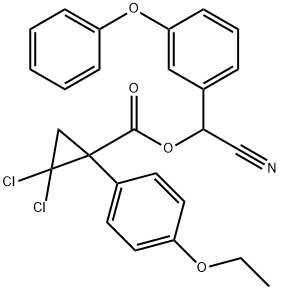
Description
Cycloprothrin is a pyrethroid insecticide. It has a low aqueous solubility and is non-volatile. It may be persistent in soil and water systems depending upon local conditions. It is not expected to leach to groundwater. Cycloprothrin tends to have a low to moderate toxicity to biodiversity depending on species. It has a low oral mammalian toxicity.
Chemical Properties
It appears as a transparent, viscous liquid. Its relative density is 1.256 (25°C), its refractive index n25D is 1.5787, and its vapor pressure is 2.13×10⁻⁶ Pa. At 25°C, its solubility in acetone, chloroform, benzene, toluene, ether, and ethyl acetate is >2000 g/L; in methanol it is 476 g/L, in ethanol it is 101 g/L, and in hexane it is 26 g/L. Its solubility in water is 0.091 mg/L. It is stable to light, acid, and heat, but unstable in alkaline solutions.
Uses
Cycloprothrin is used to control rice water weevils and other
insects in paddy rice, fruit, vegetables, tea, cotton, soyabeans and in
forestry.
Definition
ChEBI: A carboxylic ester having 2,2-dichloro-1-phenylcyclopropanecarboxylic acid as the acid component and hydroxy(3-phenoxyphenyl)acetonitrile as the alcohol component.
Production Methods
Cycloprothrin is commercially produced via a process that starts with the preparation of (1R)-cis-chrysanthemic acid through resolution of racemic 2,2-dimethyl-3-(2-methylprop-1-enyl)cyclopropanecarboxylic acid using (R)-1-phenylethylamine, followed by acid chloride formation with thionyl chloride. The key esterification couples the acid chloride with 2-(4-chlorophenyl)-3-methylbutyric acid cyanohydrin under basic conditions, incorporating the alpha-cyano group. Final purification via high-vacuum distillation or crystallisation from hexane yields cycloprothrin.
General Description
Cycloprothrin is an insecticide, used for controlling insect pests on rice plants and vegetables.
Mechanism of action
Contact and stomach action, also has anti-feeding and repellent effects. Sodium channel modulator.
Metabolic pathway
The structure of the acid moiety of cycloprothrin is rather unusual and
thus deserves special attention. The compound has two chiral centres and
therefore is a mixture of four stereoisomers; it is used as such. Degradation
and metabolism studies have been reported for flooded soil, rice
plants and rat. The results show that cycloprothrin is degraded by oxidation,
hydrolysis and conjugation reactions as are other members of the
class. However, metabolism in rice is very slow.
Degradation
Cycloprothrin is a stable compound but it is hydrolysed under alkaline
conditions. It is relatively stable to photodegradation.
Pesticide Type
Insecticide