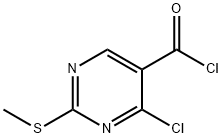
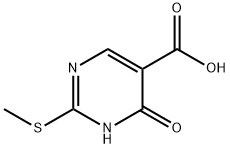
General procedure for the synthesis of 4-chloro-2-(methylthio)pyrimidine-5-carbonyl chloride from 4-hydroxy-2-(methylthio)pyrimidine-5-carboxylic acid: first, a suspension of potassium trimethylmethylsilanesulfonate (90% industrial, 40 g, 0.31 mol) in 1,2-dimethoxyethane (300 mL) was slowly added over a 20-minute period to a 4-chloro-2-(methylthio)-5- pyrimidine carboxylic acid ethyl ester (Aldrich, 15 g, 64 mmol) in a solution of 1,2-dimethoxyethane (100 mL). A mild exotherm was observed during the addition and an ice bath was used to maintain the reaction system at ambient temperature. After the addition was completed, the resulting suspension was stirred at ambient temperature for 1 hour, followed by heating and refluxing for 36 hours, after which it was cooled to ambient temperature. The reaction mixture was quenched with 1 M aqueous hydrochloric acid and then extracted with ethyl acetate and the organic phase was dried over sodium sulfate to give the crude product (11 g). The crude product was recrystallized in ethyl acetate to give 4-hydroxy-2-methylthiopyrimidine-5-carboxylic acid as a white solid (8.8 g, 47 mmol, 73% yield). Mass spectrum (-ESI) m/z 185 (M-, 100). A portion of the product (3.00 g, 16.1 mmol) was mixed with thionyl chloride (90 mL), catalyzed by the addition of DMF (0.20 mL), and the mixture was heated to reflux. After refluxing for 1 hour, it was cooled to ambient temperature and concentrated in vacuum to give a beige solid. The solid was successively ground with hot toluene and hot hexane (the soluble portion was the target product), and vacuum concentration gave 4-chloro-2-(methylthio)pyrimidine-5-carbonyl chloride as a white solid (3.90 g, 15.6 mmol, 97% yield).1H NMR (300 MHz, CDCl3) δ 9.15 (s, 1H), 2.63 (s, 3H).