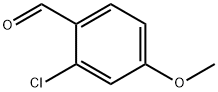
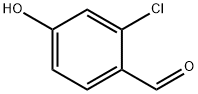
General procedure for the synthesis of 2-chloro-4-methoxybenzaldehyde from 2-chloro-4-hydroxybenzaldehyde and iodomethane: Referring to the method of Example 20, to a solution of 2-chloro-4-hydroxybenzaldehyde (2 g, 12.8 mmol) in N,N-dimethylformamide (25 mL) was added potassium carbonate (3.46 g, 25 mmol) and iodomethane (in excess) and the reaction mixture was room temperature and stirred for 18 hours. After completion of the reaction, water was added to the mixture and extracted with ethyl acetate. The organic layer was washed with saturated brine and dried over anhydrous sodium sulfate. Subsequently, the solvent was removed by distillation under reduced pressure to give almost pure 2-chloro-4-methoxybenzaldehyde (1.55 g, 70% yield). The product was characterized by 1H-NMR (δppm, CDCl3): 3.89 (3H, s), 6.84-6.95 (2H, m), 7.90 (1H, d, J = 8.8 Hz), 10.33 (1H, s).