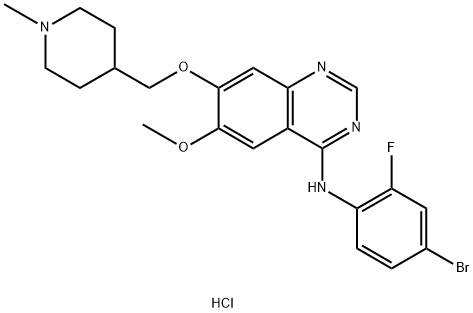
Uses
Vandetanib hydrochloride (D6474 hydrochloride) is a potent, orally active inhibitor of VEGFR2/KDR tyrosine kinase activity (IC50=40 nM). Vandetanib hydrochloride also has activity versus the tyrosine kinase activity of VEGFR3/FLT4 (IC50=110 nM) and EGFR/HER1 (IC50=500 nM)[1].
Biological Activity
vandetanib is an anti-cancer drug that is used for the treatment of certain tumours of thethyroid gland. it acts as a kinase inhibitor of a number of cell receptors, mainly the vascular endothelial growth factor receptor (vegfr), the epidermal growth factor receptor (egfr), and the ret-tyrosine kinase.
in vitro
vandetanib also inhibits vegfr3 and egfr with ic50 of 110 nm and 500 nm, respectively. vandetanib is not sensitive to pdgfrβ, flt1, tie-2 and fgfr1 with ic50 of 1.1-3.6 μm, while almost has no activity against mek, cdk2, c-kit, erbb2, fak, pdk1, akt and igf-1r with ic50 above 10 μm. vandetanib inhibits vegf-, egf- and bfgf-stimulated huvec proliferation with ic50 of 60 nm, 170 nm and 800 nm, with no effect on basal endothelial cell growth. vandetanib inhibits tumor cell growth with ic50 of 2.7 μm (a549) to 13.5 μm (calu-6) [2]. both gefitinib and vandetanib suppressed the activation of egfr and mapk in h1650 cells, although phosphorylated akt levels were not affected. in an h1650 cell xenograft model, vandetanib was also more effective than gefitinib [3].
in vivo
in tumor-bearing mice, vandetanib suppressed phosphorylation of vegfr-2 and egfr in tumor tissues, significantly reduced tumor vessel density, enhanced tumor cell apoptosis, suppressed tumor growth, improved survival, reduced number of intrahepatic metastases, and upregulated vegf, tgf-α, and egf in tumor tissues [4]. animals were treated for 28 days with 1 mg/kg/d (dtx1) or 6 mg/kg q4d (dtx6) docetaxel with or withoutvandetanib (15 mg/kg/d p.o.) in mice bearing umscc2 tumor xenografts. the dtx1 dosing scheme was adjusted to treatment for 10 days followed by 9 days off due to severe gastrointestinal toxicity [5].
IC 50
40 nm (vegfr2) [1]; 500 nm (egfr) [2]
References
[1] Wedge SR, et al. ZD6474 inhibits vascular endothelial growth factor signaling, angiogenesis, and tumor growth following oral administration. Cancer Res. 2002 Aug 15;62(16):4645-55. PMID:12183421
[2] Hegedus C, et al. Interaction of the EGFR inhibitors gefitinib, vandetanib, pelitinib and neratinib with the ABCG2 multidrug transporter: implications for the emergence and reversal of cancer drug resistance. Biochem Pharmacol. 2012 Aug 1;84(3):260-7. DOI:
10.1016/j.bcp.2012.04.010[3] Takeda H, et al. Vandetanib is effective in EGFR-mutant lung cancer cells with PTEN deficiency. Exp Cell Res. 2013 Feb 15;319(4):417-23. DOI:
10.1016/j.yexcr.2012.12.018[4] Inoue K, et al. Vandetanib, an inhibitor of VEGF receptor-2 and EGF receptor, suppresses tumor development and improves prognosis of liver cancer in mice. Clin Cancer Res. 2012 Jul 15;18(14):3924-33. DOI:
10.1158/1078-0432.CCR-11-2041