Description
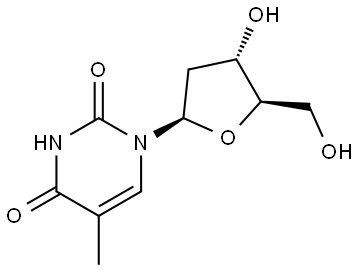
Thymidine is a pyrimidine nucleoside that is composed of the pyrimidine base thymine attached to the sugar deoxyribose. As a constituent of DNA, thymidine pairs with adenine in the DNA double helix. In cell biology it is used to synchronize the cells in G
1/early S phase.
1,2
Chemical Properties
White crystalline powder
Physical properties
Thymidine can exist in vitro conditions as a solid (as white crystals or as white crystalline powder). Under standard temperature and pressure, the stability of this compound is very high. As a part of DNA structure, thymidine occurs in living organisms (also in DNA viruses). Therefore, it is a non-toxic compound. In RNA, there is uridine instead of thymidine. Uridine is formed from the combination of uracil with ribose sugar. The key difference between thymine and thymidine is that thymine is a nucleobase, whereas thymidine is a nucleoside.
Uses
Constituent of deoxyribonucleic acid
Uses
Used for e.g. syntheses of zidovudine. Attributes For further information please contact us Contact
Application
Some antiviral drugs, especially those targeting retroviruses such as HIV, are thymidine analogs. For example, zidovudine (AZT) is a thymidine analog that can be mistakenly used by viral reverse transcriptase to synthesize DNA, thereby interrupting the viral replication process.
General Description
Thymidine is also referred to as pyrimidine deoxynucleoside. Deoxythymidine is a nucleoside present in DNA. In a DNA double stranded structure, thymidine pairs with deoxyadeninosine.
Biochem/physiol Actions
Thymidine is useful in cell synchronization during S-phase. In the salvage pathway of pyrimidines, pyrimidine phosphorylase reversibly converts thymine to thymidine.
Mechanism of action
High concentrations of thymidine interrupt the deoxynucleotide metabolism pathway through competitive inhibition, thus blocking DNA replication. A single treatment with thymidine arrests cells throughout S phase, so a double treatment acts to induce a more uniform block in early S phase.
Purification Methods
Crystallise �-thymidine from ethyl acetate, MeOH/Et2O (m 188o) or H2O (as 2H2O m 189o). It is soluble in water and hot organic solvents. The picrate has m 230o (from EtOH).
References
[1] CARLOS LOPEZ-GOMEZ PHD, PHD Michio H M. Deoxycytidine and Deoxythymidine Treatment for Thymidine Kinase 2 Deficiency[J]. Annals of Neurology, 2017, 81 5: 641-652. DOI:
10.1002/ana.24922