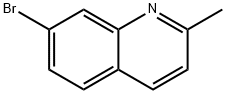
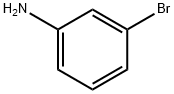
Doebner-Miller Synthesis: 3-Bromoaniline (10 mL, 92 mmol) was slowly added to a 37% hydrochloric acid solution (200 mL) pre-cooled to 0°C. Subsequently, trimeric acetaldehyde (11 mL, 0.8 mol, 9 equiv) was added dropwise to the reaction system. The reaction mixture was stirred at room temperature for 1 hour and then heated to reflux temperature to continue the reaction for 3 hours. Upon completion of the reaction, the mixture was cooled to 0 °C and saturated aqueous sodium hydroxide solution (200 mL) was slowly added to neutralize the acidity. The reaction mixture was extracted with dichloromethane (200 mL x 3) and the organic phases were combined. The organic phase was washed with water and saturated saline in turn, dried over anhydrous magnesium sulfate and concentrated under reduced pressure to obtain the crude product. The crude product was a mixture of 5-bromoquinolidine and 7-bromoquinolidine, which was separated and purified by column chromatography (silica gel, cyclohexane-ethyl acetate=9:1) to obtain the 7-bromoquinolidine regiosemide as a light yellow solid (9.3 g, 46% yield). Molecular formula: C10H8BrN. molecular weight: 222.08 g/mol. IR (thin film method): 1610, 1494, 1264, 841, 736 cm-1. melting point: 57°C. 1H NMR (CDCl3): δ 8.09 (s, 1H, H8), 7.80 (d, J = 8.2 Hz, 1H, H4), 7.39 (m, 2H, H5 and H7). 2H, H5 and H7), 7.12 (d, J = 8.2 Hz, 1H, H3), 2.61 (s, 3H, H9).13C NMR (CDCl3): δ 160.3 (C2), 148.6 (C8a), 136.2 (C4), 131.2 (C8), 129.4 (C5), 128.9 (C6), 125.3 ( C4a), 123.7 (C7), 122.6 (C3), 25.7 (C9).