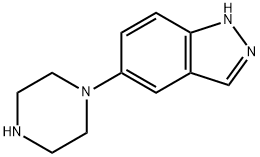
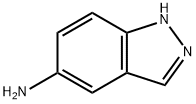
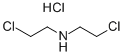
5-Aminoindazole (2.53 g, 19.0 mmol) and bis(2-chloroethyl)amine hydrochloride (3.60 g, 20.1 mmol) were mixed in ethanol (30 mL) and heated to reflux overnight. After the reaction was completed, the mixture was cooled to room temperature. Sodium carbonate (2.14 g, 20.2 mmol) was added and the reaction mixture was again heated to reflux for 8 hours. After cooling, the mixture was filtered and the filtrate was concentrated by evaporation under vacuum. The residue was dissolved in 1N hydrochloric acid (100 mL) and extracted with dichloromethane (2 x 50 mL). The aqueous phase was alkalized with 4N sodium hydroxide (30 mL) and extracted with ethyl acetate (2 x 100 mL). The organic layers were combined, washed with brine, dried and concentrated. The residue was purified by column chromatography (eluent ratios from 20:1 dichloromethane/methanol to 20:1:0.5 dichloromethane/methanol/triethylamine) to afford 5-(piperazin-1-yl)-1H-indazole (1.26 g, 33% yield) as a brown solid. The product was confirmed by 1H NMR (DMSO-d6, 400 MHz) and LCMS (APCI+): 1H NMR δ 12.80 (s, 1H), 7.89 (s, 1H), 7.40 (d, J = 8.8 Hz, 1H), 7.16 (dd, J = 8.8 Hz, J = 2.0 Hz, 1H), 7.07 (s, 1H), 3.17 (s, 1H), 2.99 (m, 4H), 2.89 (m, 4H); LCMS m/z 203 [M + H]+, Rt = 1.33 min.