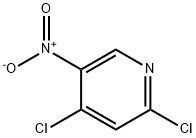
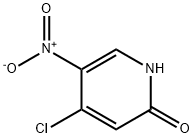
Step 3. Synthesis of 2,4-dichloro-5-nitropyridine: The product of step 2, 2-hydroxy-4-chloro-5-nitropyridine (40.0 g, 229 mmol), was suspended in toluene (300 mL), and phosphorus oxychloride (POCl3, 65 mL, 697 mmol) was added dropwise over a period of 10 min. Subsequently, the reaction mixture was heated to reflux and maintained for 6 hours. Upon completion of the reaction, the mixture was cooled to 60 °C and stirred continuously at this temperature overnight. The non-homogeneous reaction mixture was cooled to room temperature and subsequently concentrated under reduced pressure to remove the solvent. The residue was carefully adjusted to an alkaline pH with saturated aqueous potassium carbonate (K2CO3). extraction was carried out with ethyl acetate (EtOAc), the organic phases were combined and washed sequentially with water and saturated brine. The organic layer was dried over anhydrous sodium sulfate (Na2SO4), filtered and the filtrate was concentrated to give the crude product as an oil. Purification by silica gel column chromatography (eluent: hexane solution of 50% ethyl acetate) afforded the title compound 2,4-dichloro-5-nitropyridine (32.5 g, 74% yield) as an orange oil, which solidified to a solid on standing. Mass spectrometry (electrospray positive ion mode, ES+) showed the molecular ion peak m/e 194 [M+H]+.