Synthesis
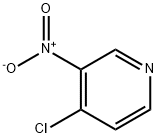
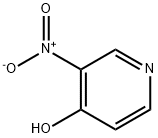
Example 1: General procedure for the synthesis of 4-chloro-3-nitropyridine from 4-hydroxy-3-nitropyridine
Step 1: Synthesis of 4-chloro-3-nitropyridine
To a suspension of 3-nitro-4-pyridinol (20 g, 143 mmol) in toluene (300 mL) was slowly added phosphorus trichloride (65.7 g, 429 mmol) at 0 °C. The reaction mixture was gradually warmed to room temperature and subsequently heated to reflux (110 °C) and held for 16 hours. After completion of the reaction, the mixture was cooled to room temperature and the solvent was removed by rotary evaporator under reduced pressure. The residue was carefully poured into ice water and the pH was adjusted with potassium carbonate (K2CO3) to 10. The aqueous phase was extracted with ethyl acetate and the organic phase was washed sequentially twice with water and once with brine. The organic phases were combined, dried over anhydrous sodium sulfate and concentrated under reduced pressure to give a brown oil, which solidified on standing to the target product 4-chloro-3-nitropyridine (22.5 g, 99% yield). Mass spectrum (electrospray positive ion mode) m/e 159 [M+H]+.
References
[1] Journal of Medicinal Chemistry, 2007, vol. 50, # 1, p. 2 - 5
[2] Patent: WO2005/37197, 2005, A2. Location in patent: Page/Page column 80; 83
[3] Patent: WO2005/37198, 2005, A2. Location in patent: Page/Page column 20
[4] Patent: WO2005/51304, 2005, A2. Location in patent: Page/Page column 70
[5] Patent: WO2005/51304, 2005, A2. Location in patent: Page/Page column 70