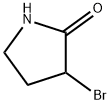
Synthesis
(1) Synthesis of 2-bromo-4-butyrolactam: Referring to the method of Example 6, 2,4-dibromobutyryl bromide was used as a raw material, and ammonia was used instead of 40% aqueous methylamine solution. 73.5 g (0.30 mol) of 2,4-dibromobutyric acid was converted to the amide (melting point 79 °C; 63% yield) to give a crystalline product. The crystals were dissolved in 650 g of THF (Guaranteed Reagent; manufactured by JUNSEI CHEMICAL Co., Ltd.). The reaction solution was cooled in an ice bath to a temperature below 100 °C, followed by the slow addition of 24 g (0.60 mol) of mineral oil 60% NaH (manufactured by JUNSEI CHEMICAL Co., Ltd.) over about 15 min. After the addition was completed, the reaction solution was warmed up to room temperature and stirred continuously for 2 hours. Upon completion of the reaction, the reaction solution was evaporated and concentrated to about one-third of the original volume, and then the concentrate was poured into 360 g of an ice-water mixture. The resulting mixture was extracted with 360 g of chloroform. The chloroform phase was collected, evaporated and concentrated, and purified by silica gel column chromatography to give 37.9 g (0.23 mol) of 2-bromo-4-butyrolactam (27% yield).
References
[1] Tetrahedron Asymmetry, 2003, vol. 14, # 17, p. 2587 - 2594
[2] Patent: WO2007/139215, 2007, A1. Location in patent: Page/Page column 49-50
[3] Journal of Medicinal Chemistry, 1987, vol. 30, # 11, p. 1995 - 1998
[4] Journal of Medicinal Chemistry, 1996, vol. 39, # 9, p. 1864 - 1871
[5] Journal of Medicinal Chemistry, 2002, vol. 45, # 10, p. 2016 - 2023