Synthesis
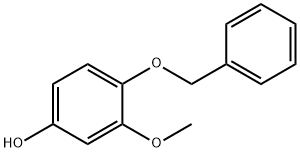
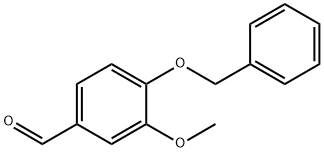
Under argon protection, 4-benzyloxy-3-methoxybenzaldehyde (S6, 25.3 g, 105 mmol) was dissolved in dichloromethane (160 mL) and cooled to 0°C. m-Chloroperbenzoic acid (containing about 30% water, purity >65%, 41.7 g, ca. 157 mmol) was added in batches. The reaction mixture was stirred for 7.5 hours and then quenched with saturated aqueous NaHCO3. The organic layer was separated after dilution with water. The aqueous layer was extracted with dichloromethane and the organic phases were combined. The combined organic phases were washed sequentially with saturated aqueous NaHCO3, water and brine, dried with Na2SO4 and concentrated. The residue was dissolved in methanol (300 mL) and K2CO3 (72.3 g, 523 mmol) was added in batches and stirred at room temperature for 1 hour. After evaporating the solvent under reduced pressure, water was added to the residue and the product was extracted with ether. The extract was washed sequentially with water and brine, dried over Na2SO4 and concentrated. The residue was recrystallized with diethyl ether-hexane to give light yellow granular 4-(benzyloxy)-3-methoxyphenol (S7, 14.7 g, 61%). The recrystallized mother liquor was concentrated and the residue was purified by silica gel column chromatography (hexane-ethyl acetate = 3:1) to give additional light yellow solid form of S7 (3.14 g, 13%).The total yield of S7 was 17.8 g (74%).
References
[1] Tetrahedron Letters, 2007, vol. 48, # 12, p. 2139 - 2141
[2] Organic Letters, 2009, vol. 11, # 11, p. 2353 - 2356
[3] Bioorganic and Medicinal Chemistry Letters, 2001, vol. 11, # 3, p. 283 - 286
[4] Synthetic Communications, 2008, vol. 38, # 5, p. 784 - 788
[5] Bioorganic and Medicinal Chemistry, 2017, vol. 25, # 24, p. 6563 - 6580