Uses
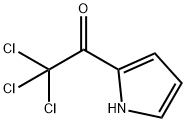
2-(Trichloroacetyl)pyrrole, is a building block used for the synthesis of more complex pharmaceutical compounds, such as Oroidin, Hymenidin and Clathrodin.
Synthesis
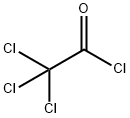
To a stirred solution of 2,2,2-trichloroacetyl chloride (25.5 mL, 0.227 mol) in anhydrous ether (45 mL) was added pyrrole (14.3 mL, 0.206 mol) slowly and dropwise at 0°C in an ice bath. The reaction mixture was stirred continuously. After the reaction was carried out for 2 days, brine solution (300 mL) was added to the reaction solution. Subsequently, the mixture was extracted with ethyl acetate (3 x 100 mL) and water (100 mL). The organic extracts were combined, dried with anhydrous magnesium sulfate (MgSO?), and then evaporated to remove the solvent to afford the target product 2,2,2-trichloro-1-(1H-pyrrol-2-yl)ethanone as a brown solid (43.6 g, 99% yield).
References
[1] Beilstein Journal of Organic Chemistry, 2015, vol. 11, p. 897 - 905
[2] Journal of Organic Chemistry, 1993, vol. 58, # 25, p. 7245 - 7257
[3] Tetrahedron Letters, 2014, vol. 55, # 49, p. 6698 - 6702
[4] Patent: EP3248968, 2017, A1. Location in patent: Paragraph 0097
[5] Organic Letters, 2011, vol. 13, # 17, p. 4550 - 4553