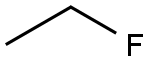
General Description
A colorless, odorless, flammable gas. Can cause asphyxiation by the displacement of air. Exposure of the container to prolonged heat or fire may cause ETHYL FLUORIDE(353-36-6) to rupture violently and rocket.
Reactivity Profile
ETHYL FLUORIDE is incompatible with strong oxidizing and reducing agents. Also, may be incompatible with many amines, nitrides, azo/diazo compounds, with alkali metals, and with epoxides.
Air & Water Reactions
Highly flammable.
Health Hazard
Vapors may cause dizziness or asphyxiation without warning. Some may be irritating if inhaled at high concentrations. Contact with gas or liquefied gas may cause burns, severe injury and/or frostbite. Fire may produce irritating and/or toxic gases.
Fire Hazard
EXTREMELY FLAMMABLE. Will be easily ignited by heat, sparks or flames. Will form explosive mixtures with air. Vapors from liquefied gas are initially heavier than air and spread along ground. CAUTION: Hydrogen (UN1049), Deuterium (UN1957), Hydrogen, refrigerated liquid (UN1966) and Methane (UN1971) are lighter than air and will rise. Hydrogen and Deuterium fires are difficult to detect since they burn with an invisible flame. Use an alternate method of detection (thermal camera, broom handle, etc.) Vapors may travel to source of ignition and flash back. Cylinders exposed to fire may vent and release flammable gas through pressure relief devices. Containers may explode when heated. Ruptured cylinders may rocket.
Uses
Monofluoroethane has excellent freezing properties and is commonly used as a refrigerant; it is also used as a foaming agent for polymer products; monofluoroethane can also be used as a solvent for some chemical reactions, such as extraction and dissolution in organic synthesis processes.