Production Methods
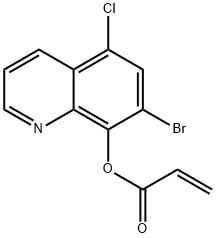
Halacrinate is synthesised through a multi-step chemical process beginning with the construction of a quinoline ring, typically via a Skraup or Doebner–Miller reaction using aniline derivatives and carbonyl compounds. The quinoline core is then selectively halogenated to introduce chlorine at position 5 and bromine at position 7 through electrophilic aromatic substitution. Next, the 8-position is activated, often by hydroxylation, to enable esterification. The final step involves coupling the activated quinoline with acrylic acid or acryloyl chloride to form the prop-2-enoate ester, completing the Halacrinate molecule.