Chemical Properties
White Solid
Uses
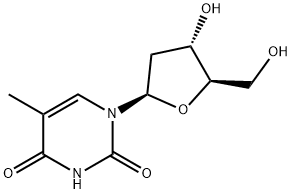
Nucleoside analog; specific inhibitor of hepatitis B virus (HBV) replication. Antiviral
Uses
Telbivudine(Tyzeka, Sebivo) is an antiviral drug used in the treatment of hepatitis B infection. Clinical trials have shown it to be significantly more effective than lamivudine or adefovir, and less likely to cause resistance. Telbivudine is a synthetic
Definition
ChEBI: A pyrimidine 2'-deoxyribonucleoside that is the L-enantiomer of thymine. A synthetic thymidine nucleoside analogue with activity against HBV DNA polymerase.
Description
Telbivudine is a b-L-thymidine nucleoside analog launched for the
once-daily oral treatment of chronic hepatitis B virus (HBV) infection. It is
the fourth nucleoside or nucleotide analog to be marketed for this indication. The
previous drugs from this class include lamivudine, a deoxythiacytosine analog,
adefovir, a nucleotide analog, and entecavir, a guanosine analog. Adefovir, entecavir,
and telbivudine are specifically indicated for HBV, whereas lamivudine is indicated for both HBV and HIV infections. Telbivudine is efficiently phosphorylated
by cellular kinases to the active triphosphate derivative, which
inhibits HBV DNA polymerase by competing with the natural substrate, thymidine-
5’-triphosphate.
Synthesis
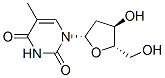
Preparation of L-thymidine: L-3',5'-diacetylthymidine (7.15 g, 21.9 mmol) was dissolved in methanol (36 mL). An 8.4 wt% ammonia/methanol solution was slowly added dropwise to this solution at room temperature. The reaction mixture was stirred at 60°C for 3 days. After completion of the reaction, the solvent was removed by concentration under reduced pressure. Ethanol (21 mL) was added to the residue and stirring was continued for 1.5 hours at room temperature. The crystals formed were collected by filtration, washed twice with ethanol (3 mL) and finally dried under reduced pressure to afford 1-((2S,4R,5S)-4-hydroxy-5-(hydroxymethyl)tetrahydrofuran-2-yl)-5-methylpyrimidine-2,4(1H,3H)-dione (4.95 g, 93.4% yield).
References
[1] Patent: EP1348712, 2003, A1. Location in patent: Page/Page column 19
[2] Patent: CN106831916, 2017, A. Location in patent: Paragraph 0049; 0050
[3] Patent: US2009/18325, 2009, A1. Location in patent: Page/Page column 5-6


![[(2S,3R,5S)-3-acetoxy-5-(5-methyl-2,4-dioxo-3,4-dihydropyrimidin-1(2H)-yl)tetrahydrofuran-2-yl]methyl acetate](/CAS/20200331/GIF/433733-94-9.gif)