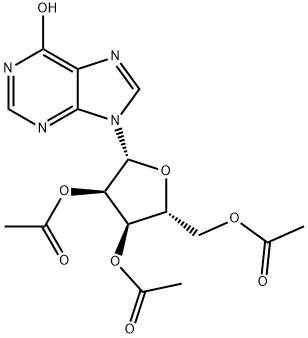
Description
2',3',5'-Tri-O-acetylinosine has been shown to inhibit the growth of cancer cells, and is also an efficient method for bond cleavage and radiation protection. 2',3',5'-Tri-O-acetylinosine has been shown to bind to pyridinium ions, and it has been used in the synthesis of tetrapeptides with hydroxyl groups or alkylation.
Uses
2',3',5'-Tri-O-acetylinosine is an intermediate used for the synthesis of 6-substituted purine ribosides
Synthesis
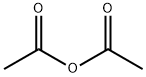
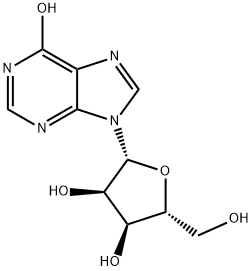
To a suspension of inosine (10 g, 37.3 mmol) and a catalytic amount of 4-dimethylaminopyridine (DMAP) in acetonitrile (60 mL) were sequentially added triethylamine (20 mL, 143 mmol) and acetic anhydride (12.5 mL). The reaction mixture was stirred at room temperature for 1 hour, followed by the slow addition of methanol (5 mL). After continued stirring for 5 min, the reaction solution was concentrated under reduced pressure to give a white solid. The solid was washed with isopropanol to afford (2R,3R,4R,5R)-2-(acetyloxymethyl)-5-(6-oxo-1H-purin-9(6H)-yl)tetrahydrofuran-3,4-diyl diacetate (triacetoxyinosine, 12.1 g, 82% yield).
References
[1] Organic and Biomolecular Chemistry, 2005, vol. 3, # 3, p. 462 - 470
[2] Synthesis, 2003, # 17, p. 2639 - 2642
[3] Journal of the American Chemical Society, 1997, vol. 119, # 32, p. 7423 - 7433
[4] Journal of Organic Chemistry, 1985, vol. 50, # 15, p. 2664 - 2667
[5] Chemistry - A European Journal, 2015, vol. 21, # 33, p. 11634 - 11643