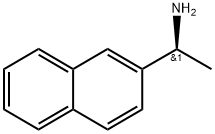
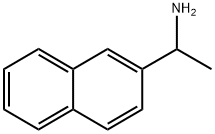
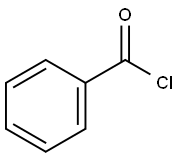
GENERAL METHODS: N-acylation reactions were carried out in cyclohexane in the presence or absence of TIPS-β-CD with racemic 1-(naphthalen-2-yl)ethylamine (1), (S)-(-)-1-(2-naphthalenyl)ethylamine (2), and 1-(naphthalen-2-yl)ethylamine (3) as the substrates, benzoyl chloride (4a-j) as the acylation reagent, and triethylamine as the base. First, racemic 1, 2, and 3 (6.0 × 10^-4 mmol) were mixed with 6-O-methylsilylated β-CD in cyclohexane (600 μL) and stirred for 1 h to reach complexation equilibrium. Subsequently, 6-O-methylsilylated β-CD, triethylamine (6.0 x 10^-4 mmol) and chloroyl chloride 4a-j were added at 10 °C. The reaction mixture was continued to be stirred for 6 h at 10 °C. Upon completion of the reaction, the product was analyzed by high performance liquid chromatography (HPLC) using a Diacel Chiralcel OD-H chiral column (250 mm × 4.6 mm I.D.) with hexane/2-propanol (80:20 or 95:5) as eluent at a flow rate of 0.5 or 1.5 mL/min and a UV detector (254 nm). The HPLC profiles of the N-acylation reaction products of 1, 2, and 3 with chloroyl chloride 4a-j (3.3 × 10^-4 mmol) in cyclohexane (600 μL), including triethylamine (6.0 × 10^-4 mmol), in the absence and presence of TIPS-β-CD (3.0 × 10^-3 mmol) are shown in Figures 1 and 2, and S18-26, respectively in.



![Benzamide, N-[(1S)-1-(2-naphthalenyl)ethyl]-](/CAS/20210305/GIF/114459-78-8.gif)
![Benzamide, N-[(1R)-1-(2-naphthalenyl)ethyl]-](/CAS/20210305/GIF/3976-23-6.gif)
