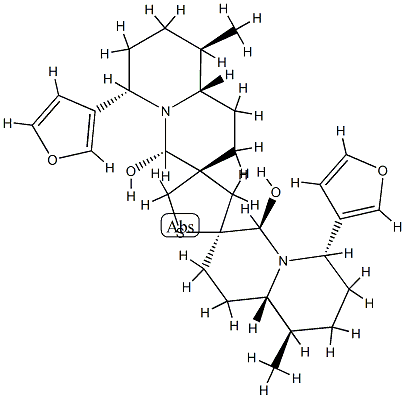
Uses
6,6′-Dihydroxythiobinupharidine is a cysteine proteases inhibitor. 6,6′-Dihydroxythiobinupharidine can enhance DNA cleavage mediated by human topoisomerase IIα and IIβ ~8-fold and ~3-fold, respectively[1][2].
Biochem/physiol Actions
6,6′-Dihydroxythiobinupharidine inhibits NFκB activation, leading to an induction of apoptosis via cleavage of procaspase-9 and poly (ADP-ribose) polymerase (PARP). It was also found to act synergistically with cytotoxic drugs such as cisplatin and etoposide, enabling their cytotoxic effect at lower concentrations. 6,6′-Dihydroxythiobinupharidine was found to have cytotoxic activity at a concentration of ~10 μM on human leukemia cells (U937), mouse melanoma cells (B16F10), and human fibroblasts (HT1080).In addition, Nuphar lutea extract was effective against both Leishmania promastigote and amastigote forms (IC50?=?2?±?0.12?μg/mL; ID50?=?0.65?±?0.023?μg/mL; LD50?=?2.1?±?0.096?μg/mL, STI?=?3.23). A synergistic antileishmanial activity was demonstrated with the antileishmanial drug, paromomycin.Recently 6,6′-dihydroxythiobinupharidine was found to be active against MRSA and VRE strains with an MIC of 1-4?μg/mL. Inhibition of DNA topoisomerase?IV but not DNA gyrase in S.?aureus was suggested as the mechanism of action. 6,6′-Dihydroxythiobinupharidine was also shown to promote neutrophil effector bactericidal functions.
References
[1] Yamahara
J, et al. Potent immunosuppressive principles, dimeric sesquiterpene
thioalkaloids, isolated from nupharis rhizoma, the rhizoma of Nuphar pumilum
(nymphaeaceae): structure-requirement of nuphar-alkaloid for immunosuppressive
activity. Biol Pharm Bull. 1996;19(9):1241-1243. DOI:
10.1248/bpb.19.1241[2] Dalvie
ED, et al. 6,6'-Dihydroxythiobinupharidine as a poison of human type II
topoisomerases. Bioorg Med Chem Lett. 2019;29(15):1881-1885. DOI:
10.1016/j.bmcl.2019.06.003