Hazard
Dangerous in contact with combustible materials. Strong oxidizing agent. Flammable.
Description
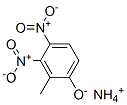
DNOC ammonium is a multiuse pesticide. Data specific to the ammonium salt is scarce but as DNOC it is highly soluble in water and is moderately volatile. It is not expected to be persistent in the environment. DNOC is moderately toxic to fish, aquatic invertebrates, algae and earthworms. It has a low oral toxicity to honeybees. It is highly toxic to mammals if ingested and is an irritant.
Production Methods
DNOC ammonium was produced commercially through the same broad pattern used for other dinitrophenol herbicides: first generate the nitrophenolic active, then convert it into a more manageable salt. Manufacturers began by nitrating para-octylphenol (or the corresponding alkylphenol feedstock) under controlled mixed-acid conditions to introduce the 2,4-dinitro substitution pattern characteristic of DNOC. After processing, the crude nitrophenol required careful purification to remove residual acids and by products that could destabilise the final product. The crude DNOC was then neutralised with aqueous ammonia in a controlled medium to produce DNOC ammonium.
Mechanism of action
Non-systemic, with contact and stomach action. Cell membrane disruption. Uncoupler of oxidative phosphorylation via disruption of proton gradient.
Pesticide Type
Herbicide; Insecticide; Acaricide; Fungicide