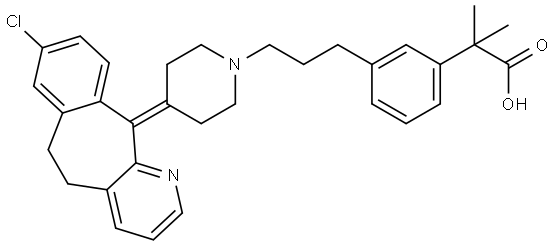
HY-078020 (5 mg/kg, i.g.) inhibits the histamine induced skin vasodilation and capillary permeability in ICR/KM mice, with a vascular permeability inhibition rates of 58.71 %[1].
HY-078020 (10 mg/kg, i.v.) exhibits aweak anticholinergic activity with an inhibition rate of salivary secretion of 10.8% in Wistar mice[1].
HY-078020 reveals a pharmacokinetic profils in mice[1]:
Pharmacokinetic Analysis of HY-078020 in wistar male rats[1]
| route | Dose (mg/kg) | T1/2 (h) | Tmax (h) | Cmax (ng/mL) | AUC0-t (ng·h/mL) | AUC0-inf (ng·h/mL) | Vd (L/kg) | CL (mL/h/kg) | MRT0-inf(h) | F (%) |
| iv | 4 | 0.653 ± 0.12 | - | - | 1678 ± 152.59 | 1822.38 ± 224.97 | 1.77 ± 0.22 | 37.00 ± 4.62 | 0.70 ± 0.14 | 59.55 |
| po | 25 | 4.05 ± 0.81 | 0.38 ± 0.16 | 1722.06 ± 337.11 | 6246.92 ± 1443.28 | 7209.70 ± 1419.01 | 21.26 ± 7.42 | 59.35 ± 10.59 | 6.01 ± 1.42 | - |
| Animal Model: | histamine-induced vascular permeability in ICR and Kunming mice[1] |
| Dosage: | 5 mg/kg |
| Administration: | i.g. |
| Result: | Reduced the vascular permeability with an inhibition rate of 58.71%. |
| Animal Model: | Wistar mice[1] |
| Dosage: | 10 mg/kg |
| Administration: | i.v., once a day |
| Result: | Inhibited salivary secretion with an inhibition rate of 10.8%. |