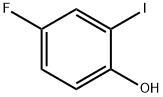
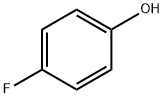
General procedure for the synthesis of 4-fluoro-2-iodophenol from 4-fluorophenol: Methanol (200 mL), 4-fluorophenol (8.00 g, 71.37 mmol), sodium iodide (12.84 g, 85.64 mmol), and sodium hydroxide (3.43 g, 85.64 mmol) were added to a round-bottomed flask fitted with a dosing funnel under nitrogen protection, maintaining the reaction temperature at 0-10°C. After stirring for 15 min, sodium hypochlorite solution (133 mL, 5% v/v, commercially available bleach, 92.77 mmol) was slowly added dropwise. After the dropwise addition was completed, stirring was continued at 0-10 °C for 1 hour. Subsequently, 100 mL of 10 wt% aqueous sodium thiosulfate was added to the reaction mixture. After acidifying the reaction mixture with 5% hydrochloric acid, it was extracted with dichloromethane (500 mL). The organic phase was washed sequentially with 500 mL of 10 wt% aqueous sodium thiosulfate solution, water and saturated saline, and then dried with anhydrous magnesium sulfate. The dried organic phase was filtered through a silica gel pad and concentrated to give an oily crude product. The crude product was purified by recrystallization from hexane to give 11.52 g of pure product in white crystal form in 67.8% yield. The structure of the product was confirmed by 1H NMR, 13C NMR and mass spectrometry: 1H NMR (500 MHz, chloroform-d) δ 7.36 (dd, J = 7.6, 2.9 Hz, 1H), 6.97 (ddd, J = 8.9, 7.7, 2.9 Hz, 2H), 6.92 (dd, J = 9.0, 4.9 Hz, 1H), 5.10 (s, 1H) ; 13C NMR (101 MHz, chloroform-d) δ 156.42 (d, J = 243.0 Hz), 151.45 (d, J = 2.6 Hz), 124.34 (d, J = 25.3 Hz), 116.83 (d, J = 23.1 Hz), 115.08 (d, J = 7.8 Hz), 84.23 (d, J = 9.0 Hz ); MS m/e 238.