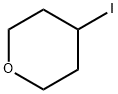
Uses
4-Iodotetrahydro-2H-pyran serves as the alkyl iodide coupling partner in palladium-catalyzed direct C–H alkylation of methyl furan-2-carboxylate, run with Pd(PPh3)4/Xantphos and Cs2CO3 in PhCF3 under argon at 110 °C, to give methyl 5-(tetrahydro-2H-pyran-4-yl)furan-2-carboxylate. Under electrochemical conditions, 4-iodotetrahydro-2H-pyran undergoes direct reduction at an onset potential of about −2.43 V vs Ag+/Ag to generate alkyl radicals that drive Minisci-type alkylation of N-heteroarenes; with 1,3-dicyanobenzene it gives the dicyclohexyl-substituted product in high yield[6-7].
Synthesis
GENERAL STEPS: Tetrahydro-2H-pyran-4-ol (2.0 g, 19.58 mmol), imidazole (1.600 g, 23.50 mmol), triphenylphosphine (5.39 g, 20.56 mmol) and tetrahydrofuran (39.2 mL) were added to a round bottom flask (RBF) and the mixture was cooled to 0 °C. A solution of iodine (5.96 g, 23.50 mmol) in tetrahydrofuran (39.2 mL) was slowly added dropwise with stirring. After dropwise addition, the reaction mixture was gradually warmed to room temperature and stirring was continued overnight. After completion of the reaction, the reaction mixture was diluted with ethyl acetate and washed with deionized water. The aqueous layer was back-extracted with ethyl acetate, all organic layers were combined, dried over anhydrous sodium sulfate, filtered and concentrated under reduced pressure. Purification of the crude product by column chromatography (using a RediSep Gold 80g silica gel column eluting with a 0-50% ethyl acetate/heptane gradient) afforded 4-iodotetrahydro-2H-pyran (2.67 g, 12.59 mmol, 64.3% yield) as a clarified light yellow oil.
References
[1] Journal of the American Chemical Society, 2017, vol. 139, # 24, p. 8110 - 8113
[2] Patent: US9212182, 2015, B2. Location in patent: Page/Page column 79
[3] Organic Letters, 2013, vol. 15, # 7, p. 1658 - 1661
[4] Patent: WO2018/106636, 2018, A1. Location in patent: Paragraph 00281
[5] Journal of the Chemical Society, 1952, p. 910,913