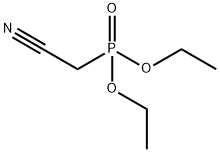
Chemical Properties
clear colorless to light yellow liquid
Uses
Diethyl cyanomethyl phosphonate is used as an intermediate in Horner-Emmons reaction for the synthesis of substituted nitriles and their amide and heterocyclic derivatives. It is known as a modified Wittig reagent used in the preparation of alpha, beta-unsaturated nitriles from ketones or aldehydes like 3-hydroxy-3-methylbutanal. It reacts with epoxides and nitrones to prepare cyano-substituted cyclopropanes and aziridines respectively. It is actively involved in the synthesis of alpha-arylated alkanenitriles via reaction with aryl iodides in presence of CuI.
Biological Functions
Diethyl cyanomethylphosphonate can be used to inhibit and/0r prevent the growth of undesirable algae, bacteria, fungi, yeast, and other microorganisms.
General Description
Diethyl cyanomethylphosphonate is a useful chemical and medical intermediate, which can be used as raw material to synthesize nitrogen-haloamine precursor AEP-ADCT containing triazine-phosphate group
reaction suitability
reaction type: C-C Bond Formation
Synthesis
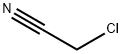
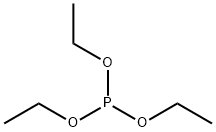
The general procedure for the synthesis of diethyl cyanomethylphosphonate from chloroacetonitrile and triethyl phosphite is as follows: 677.5 g (4.0 mol) of triethyl phosphite is heated to 150 °C. At 150 °C, 152.4 g (2.0 mol) of chloroacetonitrile was slowly added dropwise, and the dropwise process lasted for 2 hours (during which the exhaust gas produced was chloroethane). After the dropwise addition was completed, the reaction mixture was continued to be stirred at 150 °C for 2 hours (until the gas escape stopped completely). Upon completion of the reaction, the mixture was distilled under reduced pressure using a small Vigreux fractionation column (height 10 cm). The fraction with a boiling range of 110-139 °C was collected at a reduced pressure of 1 mbar, which was the target product diethyl cyanomethyl phosphate. The product yield was 99% in chloroacetonitrile (based on GC area percentage).
References
[1] Patent: WO2005/63780, 2005, A1. Location in patent: Page/Page column 13
[2] Heterocycles, 2014, vol. 89, # 2, p. 375 - 397
[3] Phosphorus, Sulfur and Silicon and Related Elements, 2000, vol. 159, p. 37 - 46
[4] Journal of the Chemical Society, Perkin Transactions 1: Organic and Bio-Organic Chemistry (1972-1999), 1981, p. 433 - 436
[5] Journal of the Chemical Society, Perkin Transactions 2: Physical Organic Chemistry (1972-1999), 1982, p. 25 - 30