Chemical Properties
White to off-white powder
Uses
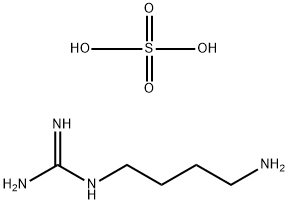
Agmatine is an intermediate in the biosynthesis of the polyamines putrescine and spermine. Agmatine binds with high affinity to α2-adrenergic receptors and imidazoline binding sites and produces blockade of the NMDA-receptor associated cation channels. Agmatine is a competitive inhibitor of nitric oxide synthase activity owing to mimicry of the natural NOS substrate arginine.
Uses
Agmatine Sulfate is a a polyamine derived from L-arginine (A769500) decarboxylation and is a known putative endogenous neurotransmitter at imidazoline receptors. Agmatine sulfate displaces clonidine a
t α2-adrenergic and at imidazoline receptors and was recently shown to exert some neuroprotective effects.
Biological Functions
Agmatine sulfate is the sulfate preparation of Agmatine. Agmatine binds with high affinity to α2-adrenergic receptors and imidazoline binding sites and produces blockade of the NMDA-receptor associated cation channels. Research found that Agmatine is stored in synaptic vesicles, is specifically degraded by agmatinase, and is released from axon terminals by depolarization all suggest that Agmatine has endogenous function as a neurotransmitter[1].
Biological Activity
Arginine metabolite that is synthesized within bovine brain and exhibits clonidine-displacing substance (CDS) activity. Putative endogenous ligand for the imidazoline binding site.
Biochem/physiol Actions
Putative endogenous neurotransmitter at imidazoline receptors; displaces clonidine at α2-adrenergic and at imidazoline receptors; blocks NMDA-activated ion channels in hippocampal neurons.
Purification Methods
Crystallise the salt from aqueous MeOH. The free base has m 101.5-103o, the gold chloride hydrochloride crystallises from H2O with m 223o(dec), and the picrate has m 236-238o. [Odo J Chem Soc Jpn 67 132 1946, Beilstein 4 I 420, 4 II 703, 4 III 575, 4 IV 1291.]