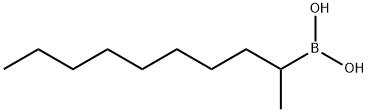
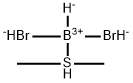
GENERAL STEPS: To a 100 mL round-bottomed flask was added a 2.1 M dichloromethane solution of dibromoborane-dimethyl sulfide complex (HBBr2-SMe2) (26.2 mL, ~55.0 mmol) and 1-decene (9.5 mL, 50.0 mmol) was added slowly and dropwise at 20 °C to the stirring solution. Subsequently, a dichloromethane solution (2.5 mL, 2.5 mmol) of 1 M boron tribromide (BBr3) was added dropwise at 0 °C. The reaction mixture was stirred at 0 °C for 15 min and then naturally warmed to 20 °C and continued stirring for 30 min. The reaction solution was slowly transferred to a flask containing a stirred mixture of ether (Et2O, 100 mL) and water (H2O, 20 mL) at 0 °C for hydrolysis, which was completed with stirring for 20 min. The mixture was transferred to a separatory funnel to minimize contact with air, and the aqueous layer was separated and discarded. The organic phase was washed sequentially with water (2 x 30 mL) and saturated brine (2 x 30 mL), dried with anhydrous magnesium sulfate, filtered and concentrated on a rotary evaporator. A free-flowing white powder product, n-decylboronic acid, was obtained in a yield of 8.71 g in 93% yield. The product was characterized by the following data: 1H NMR δ 6.50 (s, 2H), 1.41 (p, J = 7.8, 7.2 Hz, 2H), 1.28 (s, 14H), 0.92-0.84 (m, 3H), 0.71 (t, J = 7.8 Hz, 2H); 13C NMR δ 32.55, 32.07, 29.79, 29.73, 29.62, 29.50, 24.53, 23.50, 22.85, 14.28; 11B NMR δ 32.32.