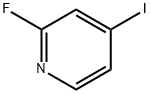
Uses
2-Fluoro-4-iodopyridine serves as a key building block in organic synthesis[6]. The compound acts as a precursor for synthesizing secondary alcohols via iodo–magnesium exchange with isopropyl magnesium chloride, followed by reaction with substituted benzaldehydes[6][8]. It undergoes palladium-catalyzed coupling with aryl or alkyl amines using Pd(OAc)2 and BINAP in anhydrous toluene with K2CO3 as base[7]. 2-Fluoro-4-iodopyridine functions as a starting material for multi-step synthetic routes, including the preparation of thrombin inhibitor analogues.
Synthesis
The general procedure for the synthesis of 2-fluoro-4-iodopyridine from 2-fluoro-3-iodopyridine was as follows: to a solution of 2-fluoro-3-iodopyridine (4.0 g, 17.9 mmol) in anhydrous THF (50 mL) was added slowly and dropwise to LDA (8.96 mL, 2 M THF solution, 17.9 mmol) at -78°C. After the reaction mixture was stirred at -78°C for 4 h, a THF (1 mL) solution of H2O (0.5 mL) was added. Subsequently, the reaction mixture was slowly warmed to room temperature and quenched by the addition of brine (30 mL). The organic layer was separated, washed with brine, dried over anhydrous Na2SO4 and concentrated to give the crude product. The crude product was purified by column chromatography to give 2-fluoro-4-iodopyridine (3.5 g, yield: 87.5%) as a white solid.LC/MS analysis showed m/z (M++H)=224.
References
[1] Organic and Biomolecular Chemistry, 2006, vol. 4, # 10, p. 1927 - 1948
[2] Journal of Organic Chemistry, 1993, vol. 58, # 27, p. 7832 - 7838
[3] Patent: WO2004/76424, 2004, A1. Location in patent: Page 85
[4] Patent: EP1559320, 2005, A1. Location in patent: Page/Page column 6
[5] Patent: WO2013/6792, 2013, A1. Location in patent: Paragraph 0189