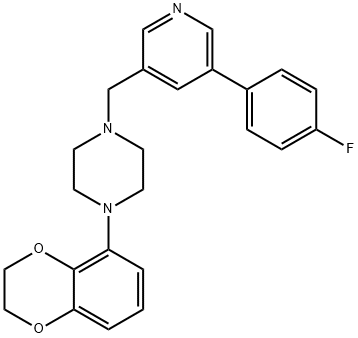
Adoprazine (SLV313) is a full 5-HT1A receptor agonist with a pEC50 of 9 at cloned h5-HT1A receptors. Adoprazine (SLV313) is a full D2 and D3 receptor antagonist with pA2s of 9.3 and 8.9 at hD2 and hD3 receptors, respectively. Adoprazine (SLV313) has the characteristics of atypical antipsychotics[1].
Biological Activity
Adoprazine (SLV313) is a full agonist at the 5-HT1A receptor with a pEC50 of 9 at the h5-HT1A receptor. Adoprazine (SLV313) is a complete antagonist of D2 and D3 receptors with a pA2 value of 9.3 in hD2 receptor and 8.9 in hD3 receptor. It (SLV313) has atypical antipsychotic properties.
in vitro
Adoprazine (SLV313) has high affinity at human recombinant D 2 , D 3 , D 4 , 5-HT < sub> 2B , and 5-HT 1A receptors, with pK i s of 8.4, 8.4, 8.0, 7.9 and 9.1 , respectively. Adoprazine (SLV313) acts as a high potency dopamine D 2 receptor antagonist and an efficacious serotonin 5-HT 1A receptor agonist, with E max value (% effect of 10 μM 5-HT) of 73 and pK B value of 8.5 .
in vivo
Adoprazine (SLV313) (0.1-10 mg/kg; po; single) is sufficient to reduce extracellular 5-HT and increase dopamine levels in the nucleus accumbens in a dose- and time-dependent manner.
Animal Model:
Male Wistar rats (275-350 g)
Dosage:
0.1 mg/kg, 0.3 mg/kg, 1 mg/kg, 3 mg/kg, 10 mg/kg
Administration:
po; single
Result :
Led to a dose- and time-dependent increase in extracellular levels of DA, DOPAC, and HVA. In contrast, led to a reduction in 5-HT levels and no change in 5-HIAA levels.
[1] Andrew C McCreary, et al. SLV313 (1-(2,3-dihydro-benzo[1,4]dioxin-5-yl)-4- [5-(4-fluoro-phenyl)-pyridin-3-ylmethyl]-piperazine monohydrochloride): a novel dopamine D2 receptor antagonist and 5-HT1A receptor agonist potential antipsychotic drug. Neuropsychopharmacology. 2007 Jan;32(1):78-94. DOI:10.1038/sj.npp.1301098 [2] Liesbeth A Bruins Slot, et al. Differential profile of antipsychotics at serotonin 5-HT1A and dopamine D2S receptors coupled to extracellular signal-regulated kinase. Eur J Pharmacol. 2006 Mar 18;534(1-3):63-70. DOI:10.1016/j.ejphar.2006.01.027