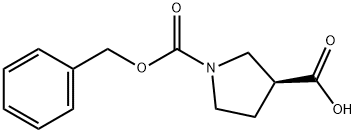
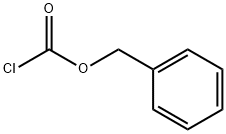
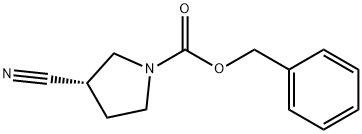
Step 1: To a 100 mL round bottom flask was added (S)-1-Cbz-3-pyrrolidinecarbonitrile (2 g, 8.7 mmol) and concentrated hydrochloric acid (20 mL). The mixture was refluxed for 4.5 h before the solvent was removed by vacuum distillation and dried overnight using an oil pump. The crude product was dissolved in a solvent mixture of acetone (20 mL) and deionized water (20 mL). After cooling to 0 °C, sodium carbonate (2.8 g, 26 mmol) was added, followed by slow dropwise addition of benzyl chloroformate (5.5 mL, 9.6 mmol). The reaction mixture was allowed to warm up gradually to room temperature. After 7 hours of reaction, the solvent was removed by vacuum distillation. Deionized water (8 mL) was added and extracted twice with a solvent mixture of hexane:EtOAc = 1:1. The aqueous layer was acidified to pH 2 by the addition of concentrated hydrochloric acid and 0.5 M potassium bisulfate.Subsequently, the aqueous layer was extracted with ethyl acetate (four times), and the organic phase was dried over sodium sulfate and concentrated by vacuum to afford (S)-1-CBZ-3-carboxypyrrolidine (1.46 g, 67% yield), which was used directly in the next step.1H NMR (CDCl3, 400 MHz): δ 7.38-7.29 (m, 5H), 5.14 (d, J = 2.8 Hz, 2H), 3.72-3.43 (m, 4H), 3.17-3.09 (m, 1H), 2.21-2.14 (m, 2H).