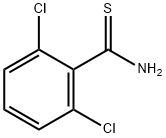
Description
Chlorthiamid is an obsolete pre-emergence herbicide once used for non-selective weed control. It is moderate soluble in water and is non-volatile. It is not persistent in soil systems and considered to be moderately mobile, and so it may leach to groundwater under certain conditions. Its toxicity to flora and fauma tends to be low to moderate. It also has a low mammalian toxicity. Little information is available on chlorthiamids potential for serious adverse health effects.
Uses
Refer to the productμs Certificate of Analysis for more information on a suitable instrument technique. Contact Technical Service for further support.
Definition
ChEBI: 2,6-dichlorothiobenzamide is a dichlorobenzene and a thiocarboxamide. It has a role as a proherbicide and an agrochemical.
Production Methods
Chlorthiamid is produced commercially through a synthesis involving chlorinated aromatic compounds and thiourea chemistry. The process typically begins with the chlorination of benzene derivatives to form 2,6-dichlorobenzoyl chloride, which is then reacted with ammonium thiocyanate or similar sulphur-containing reagents to introduce the thioamide functional group. This reaction yields the active compound, chlorthiamid, under controlled temperature and solvent conditions to ensure purity and yield. Once synthesised, the product is purified and formulated.
Mechanism of action
Systemic, absorbed by roots and leaves, acting against germinating seeds. Inhibits cell wall synthesis
Metabolic pathway
Twelve metabolites are isolated from either urine or
bile from either rats (11 metabolites) or goats (seven
metabolites) given single oral doses of 14C-labeled
2,6-dichlorobenzonitrile (DCBN). Five of these
metabolites are also excreted in urine from rats dosed
orally with 2,6-dichlorothiobenzamide (DCTBA) which
is an acid amide analog. All metabolites from either DCBN or DCTBA are benzonitriles with the following
ring substituents: Cl2, OH (three isomers); Cl2, (OH)2;
Cl, (OH)2; Cl, OH, SH; Cl, OH, SCH3; SOCH3, OH;
Cl2, S-(N-acetyl)cysteine; Cl, S-(N-acetyl)cysteine; Cl,
OH, S-(N-acetyl)cysteine.
The thiobenzamide moiety of DCTBA is converted
to the nitrile in all extracted urinary metabolites. No
hydrolysis of the nitrile in DCBN to either amide or an
acid is detected. Urine is the major route for excretion;
however, enterohepatic circulation occurs.