Synthesis
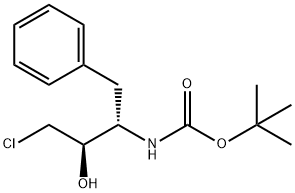
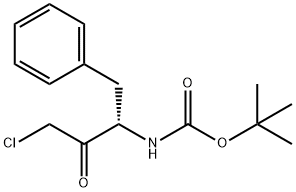
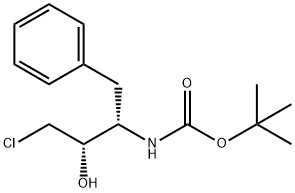
The synthesis of tert-butyl (1S,2S)-(1-benzyl-3-chloro-2-hydroxypropyl)carbamate and (2R,3S)-3-tert-butoxycarbonyl-1-chloro-2-hydroxy-4-phenylbutane was carried out via ruthenium-catalyzed asymmetric hydrogenation using (3S)-3-(tert-butoxycarbonyl)amino-1-chloro-4-phenyl-2-butanone as the starting material. The experiments were catalyzed using different ruthenium ligands under the following reaction conditions: substrate 1 mmol, substrate to catalyst ratio (S/C) of 100:1, solvent 4 mL methanol, and reaction time 20 h (not optimized). The reaction temperature and pressure were adjusted according to the catalyst type, and the results are shown in Table 1.Entry 1 used Ru(S-Xyl-P-Phos)(acac) as the catalyst and was reacted at 50 °C and 1 bar pressure, resulting in a conversion of 51%, with the major product in the (2R,3S)-configuration, and an enantiomeric excess (de) of 82%.Entry 2 used Ru(SP -Phos)Cl2(dmf) as a catalyst at 65 °C and 20 bar pressure resulted in 89% conversion with the same (2R,3S)-configuration as the major product and an enantiomeric excess (de) of 79%.
References
[1] Journal of Medicinal Chemistry, 1994, vol. 37, # 12, p. 1758 - 1768
[2] Journal of Medicinal Chemistry, 1994, vol. 37, # 12, p. 1758 - 1768
[3] Journal of Organic Chemistry, 2004, vol. 69, # 21, p. 7344 - 7347
[4] Journal of Organic Chemistry, 2004, vol. 69, # 21, p. 7391 - 7394
[5] Journal of Organic Chemistry, 2004, vol. 69, # 21, p. 7391 - 7394