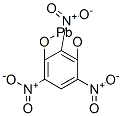
Chemical Properties
hexagonal platelets
General Description
A slurry or wet mass of orange-yellow crystals. Must be shipped wet with at least 20% water or water and denatured ethyl alcohol mixture. May explode due to shock, heat, flame, or friction if dried. Used as an initiating explosive. The primary hazard is the blast of an instantaneous explosion and not flying projectiles and fragments.
Reactivity Profile
LEAD STYPHNATE is a weak but highly sensitive explosive. An employee removing a beaker of lead styphnate from a laboratory oven caused a detonation when he bumped the beaker on the side of the oven [MCA Case History 957, 1966]. Three kilograms of lead styphnate exploded from an unknown cause. Wet material in two adjacent dry rooms did not detonate [Chem. Abs. 26:5210. 1932]. May react vigorously with reducing agents.
Health Hazard
Fire may produce irritating, corrosive and/or toxic gases.
Fire Hazard
MAY EXPLODE AND THROW FRAGMENTS 1600 meters (1 MILE) OR MORE IF FIRE REACHES CARGO.
Uses
Lead Styphnate is an explosive compound used in primers and detonator mixtures for less sensitive secondary explosives.