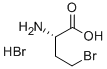
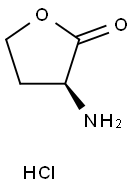
The general procedure for the synthesis of L(+)-2-amino-4-bromobutyric acid hydrobromide from L-homoserine lactone hydrochloride is as follows:
Example 14: Compound 322 ((2R,6S,13aS,14aR,16aS,Z)-6-(tert-butoxycarbonylamino)-14a-(2,5-dichlorothiophene-3-ylsulfonylcarbamoyl)-5,16-dioxo-2,3,5,6,7,8,10,11,13a,14,14a,15,16,16a-tetradecahydro- 1H-cyclopropan[e]pyrrolo[1,2:1,6,9]oxadiazole cyclopentadien-2-yl)4-chloroisoindole-2-carboxylate) was prepared as follows:
Step 1: Synthesis of (-S)-2-amino-4-bromobutyric acid hydrobromide
3-Aminodihydrofuran-2(3H)-one hydrochloride (10.30 g, 74.87 mmol) was dissolved in 58 mL of a 30% w/w HBr solution of acetic acid and the reaction was stirred at 65 °C for 30 hrs. After completion of the reaction, the solvent was removed by distillation under reduced pressure. The resulting solid was suspended in methyl tert-butyl ether (MTBE, 200 mL) and stirred for 30 minutes. The solid was collected by filtration, washed with MTBE (200 mL) and dried to give the target product (98% yield).
Product characterization: 1H NMR (400 MHz, DMSO-d6) δ 8.37 (s, 3H), 4.01 (m, 1H), 3.65 (m, 2H), 2.33 (m, 2H).