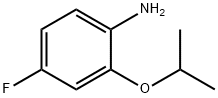
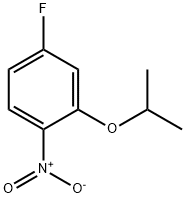
General procedure: 4-fluoro-2-isopropoxy-1-nitrobenzene (49.3 g, 248 mmol), ethanol (600 mL), and 10% Pd/C catalyst (50% aqueous solution, Degussa type E101; 10 g, equivalent to 20% of the mass of starting nitro compounds) were added to a round bottom flask. The flask was sealed with a rubber septum and three evacuation-hydrogen backfill cycles were performed to degas. The reaction mixture was stirred for 4 days at room temperature under hydrogen atmosphere (using a hydrogen balloon to maintain pressure). Upon completion of the reaction, the mixture was filtered through a diatomaceous earth pad and the diatomaceous earth pad was washed well with methanol. The filtrate and washings were combined and concentrated to dryness under reduced pressure to afford a brown liquid 4-fluoro-2-isopropoxyaniline (41.0 g, 98% yield), which can be used in subsequent reactions without further purification. The product was characterized as follows: 1H NMR (300 MHz, DMSO-d6) δ 6.67-6.72 (dd, 1H, J = 2.7, 11.0 Hz), 6.55-6.60 (dd, 1H, J = 6.0, 8.7 Hz), 6.43-6.49 (td, 1H, J = 2.7, 8.4 Hz), 4.47-4.55 (m , 3H), 1.23-1.25 (d, 6H, J = 6.0 Hz); 19F NMR (282 MHz, DMSO-d6) δ -127.4 (sextet); MS (ESI) m/z = 170 [M+H]+.