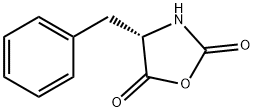
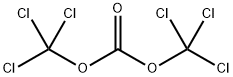
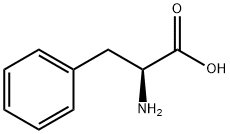
2.3 Preparation of 1-phenylalanine N-carboxylic anhydride (NCA) (Scheme 2)
A 1L round bottom flask was dried in an oven (oven temperature = 120°C) before use. The glassware was cooled to room temperature under inert nitrogen atmosphere. L-phenylalanine (50.0 g, 303 mmol) was added to the flask, followed by anhydrous THF (600 mL, 0.5 M) to form a suspension of white solids. The mixture was heated to 50 °C and then triphosgene (35.9 g, 121 mmol, 0.4 eq.) was added in batches. The suspension was stirred continuously until the reaction mixture became clear (about 30 minutes). The reaction mixture was cooled to room temperature and subsequently concentrated to an oil in a rotary evaporator. The oily substance was slowly poured into 3 L of hexane under rapid stirring to produce a white precipitate. The flask was covered with aluminum foil and the resulting suspension was allowed to stand in a refrigerator for 3 hours. The white precipitate was collected by vacuum filtration while maintaining an inert nitrogen atmosphere. The white solid was washed with hexane (3 x 20 mL) to remove residual THF and triphosgene. The product was dried overnight under vacuum to give a white solid (54.0 g, 94% yield). The product was confirmed by GC/MS.1H NMR (500 MHz, CDCl3): δ 7.37-7.30 (3H, m); 7.18 (2H, d, J=7.21 Hz); 6.23 (1H, s); 4.53 (1H, dd, J=8.18,4.21 Hz); 3.27 (1H, dd, J=14.14, 4.20 Hz); 3.00 (1H, dd, J=14.13,8.17 Hz).