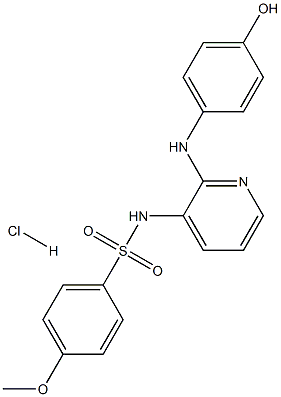
[1] Huang SM et al.,Tankyrase inhibition stabilizes axin and antagonizes Wnt signalling., Nature. 2009 Oct 1;461(7264):614-20. DOI:
10.1038/nature08356[2] Elizabeth Fox et al. A Phase I Study of ABT-751, an Orally Bioavailable Tubulin Inhibitor, Administered Daily for 21 Days Every 28 Days in Pediatric Patients with Solid Tumors Clin Cancer Res February 15, 2008 14; 1111
[3] Aggarwal C, et al. Antiangiogenic agents in the management of non-small cell lung cancer: where do we stand now and where are we headed?,Cancer Biol Ther. 2012 Mar;13(5):247-63. DOI:
10.4161/cbt.19594[4] Silver M, Rusk A, Phillips B, Beck E, Jankowski M, Philibert J, Hahn K, Hershey E, McKeegan E, Bauch J, Krivoshik A, Khanna C.,Evaluation of the oral antimitotic agent (ABT-751) in dogs with lymphoma.,J Vet Intern Med. 2012 Mar-Apr;26(2):349-54. doi: 10.1111/j.1939-1676.2012.00892.x. Epub 2012 Feb 28. DOI:
10.1111/j.1939-1676.2012.00892.x[5] Gaynon PS, Harned TM; for the Therapeutic Advances in Childhood LeukemiaLymphoma (TACL) Consortium. DOI:
10.1097/MPH.0b013e3182532446[6] Yoshimatsu K, et al. Mechanism of action of E7010, an orally active sulfonamide antitumor agent: inhibition of mitosis by binding to the colchicine site of tubulin. Cancer Res. 1997;57(15):3208-3213. PMID:9242451
[7] Morton CL, et al. Evaluation of ABT-751 against childhood cancer models in vivo. Invest New Drugs. 2007;25(4):285-295. DOI:
10.1007/s10637-007-9042-y[8] David Frost, et al. ABT-751, an oral antimitotic, shows additive and synergistic activity with docetaxel in preclinical models. Cancer Res 1 May 2007; 67 (9_Supplement): 1426.