Description
Fluquinconazole is a selective protectant and curative fungicide used to control various endophytic diseases mainly on cereals. It has a low aqueous solubility and a low volatility. It can be persistent in both soil and water systems depending on local conditions. Oral toxicity to mammals is classified as moderate but data for chronic health is missing. Toxicity to birds is high and tends to be moderate to most otherr species but slightly less so to bees.
Chemical Properties
Fluoroquinazole pure product is white crystalline solid with a slight odor. Melting point 191.9~193℃. Vapor pressure 6.4×10⁻⁹Pa(20℃). Distribution coefficient KowlgP=3.24(pH 5.6,20℃).Henry constant 2.09×10⁻⁶Pa -m3/mol(20℃). Relative density 1.58(20℃). Solubility (20℃,g/L): water 0.0015(pH 6.6), acetone 38~50, xylene 9.88, ethanol 3.48, DMSO150~200, dichloromethane 120~150.Stability: in water DT50(25℃ ,pH 7) 21.8d.Stable in aqueous medium to light. Surface tension 70.91mN/m(20℃).
Uses
Agricultural fungicide primarily for cereal crops.
Uses
Fluqinconazole is used to control a wide range of Ascomycetes,
Deuteromycetes and Basidiomycetes, by foliar application, on broadleaved
and cereal crops.
Definition
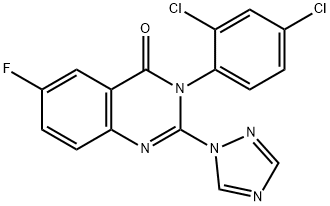
ChEBI: Fluquinconazole is a member of the class of quinazolines that is 6-fluoroquinazolin-4-one carrying additional 1,2,4-triazol-1-yl and 2,4-dichlorophenyl substituents at positions 2 and 3 respectively. A fungicide used to control Ascomycetes, Deuteromycetes and Basidiomycetes spp. on cereals, beets and fruit. It has a role as an EC 1.14.13.70 (sterol 14alpha-demethylase) inhibitor and an antifungal agrochemical. It is a member of quinazolines, a dichlorobenzene, a member of triazoles, an organofluorine compound, a conazole fungicide and a triazole fungicide.
Production Methods
Fluquinconazole is commercially synthesised through a multi-step process that constructs its quinazolinone-triazole core. The synthesis begins with the preparation of 6-fluoroquinazolin-4-one, which serves as the central scaffold. This intermediate is then functionalized at the 2-position with a 1,2,4-triazol-1-yl group and at the 3-position with a 2,4-dichlorophenyl substituent. These substitutions are typically achieved through nucleophilic aromatic substitution and condensation reactions using appropriate halogenated precursors and triazole derivatives. The reactions are conducted under controlled temperature and solvent conditions to ensure high yield and purity.
Mechanism of action
Absorbed through foliage. Systemic with protectant and eradicant activity. Disrupts membrane function. Sterol biosynthesis inhibitor.
Metabolic pathway
The limited available published information states that fluconquinazole is
metabolised to 1,2,4-triazole in plants and mammals. In soils it is hydrolysed
slowly.
Degradation
Fluquinconazole is stable to light with a DT50 in water of 21.8 days (25 °C,
PH 7> (PM).