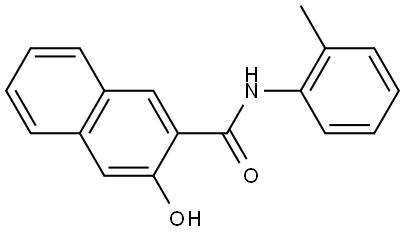
Chemical Properties
Beige powder. Soluble in solvent naphtha. Insoluble in water and soda ash solution.
Uses
Naphthol AS-D is a primary red base dye for cotton fibers, and is also mainly used as a base dye for cotton fabrics in dyeing and printing. Its properties are similar to Naphthol AS, and it can be mixed to adjust color. When combined with red base B, it dyes maroon; when combined with red base RL, it dyes magenta. When used as a base dye for cotton printing, it can be combined with different base dyes to obtain various colors such as orange, red, purple, and blue. It has low affinity for cotton and moderate coupling ability. It is also used for dyeing and printing viscose fibers such as vinylon, viscose, silk, and diacetate, as well as some synthetic fibers. It is also used in the production of insoluble azo dyes and in the manufacture of fast pigments, lake pigments, and organic pigment intermediates.
Preparation
O-Methylaniline and 3-Hydroxy-2-naphthoic acid condensation.
Flammability and Explosibility
Nonflammable
Properties and Applications
yellowish powder, melting point for 195 ~ 196 ℃. Insoluble in water solution and sodium carbonate, soluble in naphtha. In sodium hydroxide solution for yellow. Sensitive to air. Mainly used for cotton yarns, cotton fabric, PVA, viscose, silk and vinegar fiber dyeing, also can be used for direct printing, the cotton print and dye discharge printing, and can be used as a quick pigment and organic pigments intermediate. The affinity of cotton is low, medium coupled ability.
Purification Methods
Purify it by recrystallisation from xylene. This gives yellow-green fluorescent solutions at pH 8.2-9.5. [IR: Schnopper et al. Anal Chem 31 1542 1959.] The naphthol AS-D acetate is obtained with AcCl, m 168-169o, and with chloroacetyl chloride naphthol AS-D-chloroacetate is obtained [Moloney et al. J Histochem Cytochem 8 200 1960, Burstone Arch Pathology 63 164 1957]. [Beilstein 12 H 505.]