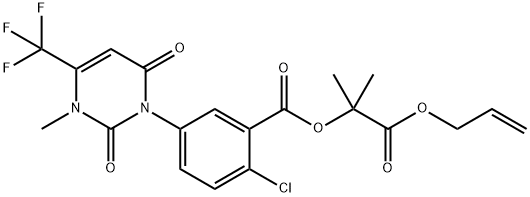
Description
Butafenacil is a herbicide used to control annual and perennial broadleaved weeds. Iit has a moderate aqueous solubility and a low volatility. It is not usually persistent in soil systems but may be moderately persistent in aquatic systems, depending on local conditions. It is moderately toxic to honeybees and most aquatic species but less so to birds and earthworms. It has a low oral mammalian toxicity and is an irritant,
Chemical Properties
The pure product is a colorless powdery solid with an mp of 113°C, a bp of 270-300°C, a relative density of 1.37 (20°C), a vapor pressure of 7.4×10⁻⁹ Pa (25°C), a distribution coefficient of 3.2, and a solubility in water of 10 mg/L at 25°C.
Uses
Butafenacil is a uracil based herbicide that function via the inhibition of protoporphyrinogen oxidase.
Definition
ChEBI: Butafenacil is an organofluorine compound that is 1-methyl-6-(trifluoromethyl)pyrimidine-2,4(1H,3H)-dione substituted by a 4-chloro-3-({[2-methyl-1-oxo-1-(prop-2-en-1-yloxy)propan-2-yl]oxy}carbonyl)phenyl group at position 3. It is a herbicide which inhibits the protoporphyrinogen-oxidase enzyme in plant chloroplasts, resulting in rapid knockdown of various broadleaf and grass weeds. It has a role as a herbicide and an EC 1.3.3.4 (protoporphyrinogen oxidase) inhibitor. It is a member of monochlorobenzenes, a benzoate ester, an organofluorine compound, a diester and an olefinic compound. It is functionally related to a uracil.
Production Methods
Butafenacil is commercially produced via a convergent 4–6 step synthesis that starts with the construction of the 2-chloro-5-(3,6-dihydro-3-methyl-2,6-dioxo-4-(trifluoromethyl)-1(2H)-pyrimidinyl)benzoic acid core through nucleophilic aromatic substitution of 2-chloro-5-fluorobenzoic acid with 6-(trifluoromethyl)uracil under basic conditions. The carboxylic acid is activated as the acid chloride. Simultaneously, 1-amino-1-cyanamino-2,2-dimethylpropane is prepared from tert-butylamine and cyanogen bromide. The key urea linkage is formed via coupling of the acid chloride with the cyanoguanidine intermediate, followed by cyclisation to the uracil ring with base
Flammability and Explosibility
Nonflammable
Mechanism of action
Non-selective, contact action absorbed by foliage. Inhibition of protoporphyrinogen oxidase (PPO) - cell membrane disruption