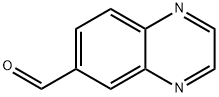
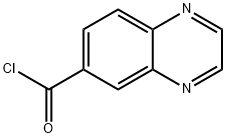
The general procedure for the synthesis of quinoxaline-6-carbaldehyde from quinoxaline-6-carbonyl chloride is as follows: in an 11-liter three-neck flask under argon protection, quinoxaline-6-carbonyl chloride was dissolved in 600 mL of 1,2-dimethoxyethane (DME). An equimolar amount of lithium tri-tert-butoxyaluminum hydride (LiAlH(Ot-Bu)3) was slowly added to this solution over a period of 1.5 hours at -78 °C. The reaction was stirred continuously at -78 °C for 5 hours. Upon completion of the reaction, the reaction was quenched by careful addition of ice water, followed by dilution of the reaction mixture with ethyl acetate (AcOEt) and filtration through a diatomaceous earth pad. The organic and aqueous layers were separated and the organic phase was washed with saturated sodium bicarbonate (NaHCO3) solution. After evaporation of the solvent under reduced pressure, quinoxaline-6-carbaldehyde was obtained in 73% yield and the product was a pale yellow solid. High performance liquid chromatography (HPLC) analysis showed a retention time of 1.49 min. Liquid chromatography-mass spectrometry (LC-MS) analysis showed a retention time of 0.81 min at m/z of 159.37 [M+H]+ in ESI positive ion mode. Nuclear magnetic resonance hydrogen spectroscopy (1H NMR, CDCl3) data were as follows: δ 10.28 (s, 1H), 8.97 (s, 2H), 8.61 (s, 1H), 8.27 (q, J=6 Hz, 9 Hz, 2H).