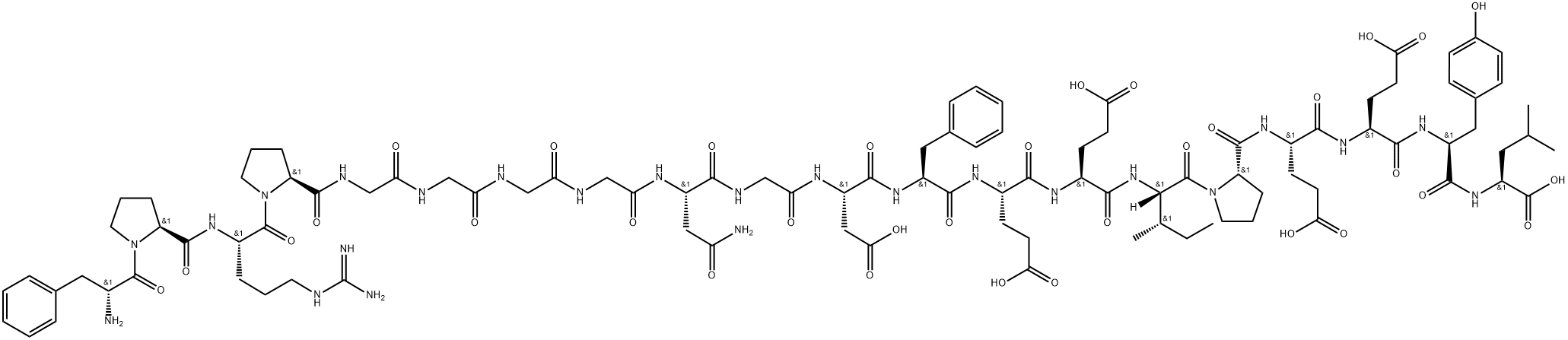
Description
Bivalirudin was launched in New Zealand as an anticoagulant for i.v. treatment of
patients with unstable angina undergoing percutaneous transluminal coronary angioplasty.
Bivalirubin is a synthetic 20 amino acid peptide rationally modeled on hirudin (residues 53-
64), the most potent and specific naturally-occuring known inhibitor of thrombin, the
enzyme that plays a key role in hemostasis and blood clot formation. This peptide is a
direct thrombin inhibitor that maintains the unique bivalent binding properties of hirudin to
the catalytic site and to the fibrin-recognition exosite of the enzyme, so acting directly on
thrombin with high affinity and specificity. In vitro studies demonstrated that alpha- and
zeta-thrombins, both with the higher fibrinogen-procoagulant activities, were inhibited. In
rats receiving high doses of bivalirudin, the platelet deposition in carotide was reduced by
63% compared to controls. The results of clinical studies, conducted only in patients
receiving concomitant aspirin, suggested that the use of bivalirudin was more efficacious
and more predictable than unfractionated heparin, with fewer bleeding complications.
Despite some unresolved developmental issues, the attractive properties of this novel
agent could make it a useful alternative to heparin in a variety of coagulation disorders.
Definition
ChEBI: A synthetic peptide of 20 amino acids, comprising D-Phe, Pro, Arg, Pro, Gly, Gly, Gly, Gly, Asn, Gly, Asp, Phe, Glu, Glu, Ile, Pro, Glu, Glu, Tyr, and Leu in sequence. A congener of hirudin (a naturally occurring drug found in the saliva o
the medicinal leech), it a specific and reversible inhibitor of thrombin, and is used as an anticoagulant.
Manufacturing Process
A 20 amino acid polypeptide [1], bivalirudin (hirulog) is a synthetic version of
hirudin. Its amino-terminal D-Phe-Pro-Arg-Pro domain, which interacts with
the active site of thrombin, is linked via four Gly residues to a dodecapeptide
analogue of the carboxy-terminal of hirudin. Like hirudin, bivalirudin also
forms a 1:1 stoichiometric complex with thrombin. Once bound, however, the
Arg-Pro bond at the amino-terminal of bivalirudin is cleaved by thrombin,
thereby restoring active site functions of the enzyme complexes of α-thrombin
[2].
Hirulog-8 has the formula: H-(D-Phe)-Pro-Arg-Pro-(Gly)4-Asn-Gly-Asp-Phe-
Glu-Glu-Ile-Pro-Glu-Glu-Tyr-Leu-OH. Hirulog-8 was synthesized by
conventional solid-phase peptide synthesis employing an Applied Biosystems
430 A Peptide Synthesizer. This peptide was synthesized using BOC-L-Leucine-
O-divinylbenzene resin. Additional t-BOC-amino acids (Peninsula Laboratories, Belmont, Calif.) used included BOC-O-2,6-dichlorobenzyl tyrosine, BOC-Lglutamic
acid (γ-benzyl ester), BOC-L-proline, BOC-L-isoleucine, BOC-Lphenylalanine,
BOC-L-aspartic acid (β-benzyl ester), BOC-glycine, BOC-Lasparagine,
BOC-L-phenylalanine, and BOC-L-arginine. In order to achieve
higher yields in synthesis, the (Gly)4 linker segment was attached in two
cycles of manual addition of BOC-glycylglycine (Beckman Biosciences, Inc.,
Philadelphia, Pa.). After completion of synthesis, the peptide was fully
deprotected and uncoupled from the divinylbenzene resin by treatment with
anhydrous HF:p-cresol:ethylmethyl sulfate (10:1:1, v/v/v). Following removal
from the resin, the peptide was lyophilized to dryness.
Crude Hirulog-8 was purified by reverse-phase HPLC employing an Applied
Biosystems 151A liquid chromatographic system and a Vydac C18 column
(2.2x25 cm). The column was equilibrated in 0.1% TFA/water and developed
with a linear gradient of increasing acetonitrile concentration from 0 to 80%
over 45 minutes in the 0.1% TFA at a flow-rate of 4.0 ml/min. The effluent
stream was monitored for absorbance at 229 nm and fractions were collected
manually. We purified 25-30 mg of crude Hirulog-8 by HPLC and recovered
15-20 mg of pure peptide.
The structure of purified Hirulog-8 was confirmed by amino acid and sequence
analyses.
Brand name
Angiomax (Medicinova).
Therapeutic Function
Anticoagulant
Biochem/physiol Actions
Bivalirudin is a specific and reversible bivalent direct thrombin inhibitor. Bivalirudin specifically binds to both the catalytic site and to the anion-binding exosite of circulating and clot-bound thrombin.
Mechanism of action
Bivalirudin is a rapid-onset, short-acting DTI that binds to both the active site and the exosite-1 of
thrombin. Unlike lepirudin, bivalirudin is a reversible inhibitor of both free thrombin and thrombin
bound to fibrin. This reversibility is possible because the bound bivalirudin undergoes cleavage at
the second N-terminal proline to release the portion of the drug bound to the active site. The
carboxyl-terminal portion of bivalirudin dissociates from thrombin to regenerate thrombin. Bivalirudin does not bind to plasma protein.
Pharmacokinetics
Bivalirudin is administered via intravenous bolus injection, followed by continuous infusion (Table
31.4). The drug exhibits a rapid onset and a short duration of action. Bivalirudin is eliminated by
renal excretion. It has been suggested that dosage adjustments be made in patients with severe
renal impairment and in patients undergoing dialysis. Approximately 30% is eliminated unchanged
along with proteolytic cleavage products. Because of the reversible nature of bivalirudin the drug
exhibits less risk of bleeding than other antithrombotics, and there have been no reported cases of
antibody formation to bivalirudin.
Clinical Use
Bivalirudin, a 20-amino-acid peptide, has been approved for use in patients with unstable angina
undergoing percutaneous coronary intervention.
Drug interactions
Potentially hazardous interactions with other drugs
Analgesics: increased risk of haemorrhage with IV
diclofenac and ketorolac.
Antiplatelets and anticoagulants: increased risk of
bleeding.
Thrombolytics: may increase risk of bleeding
complications; enhance effect of bivalirudin.
Metabolism
As a peptide, bivalirudin is expected to undergo catabolism
to its constituent amino acids, with subsequent recycling of
the amino acid in the body pool. Bivalirudin is metabolised
by proteases, including thrombin. The primary metabolite
resulting from the cleavage of Arg3
-Pro4
bond of the
N-terminal sequence by thrombin is not active because of
the loss of affinity to the catalytic active site of thrombin.
References
[1]. shammas n w. bivalirudin: pharmacology and clinical applications[j]. cardiovascular drug reviews, 2005, 23(4): 345-360.