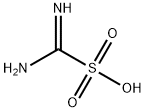
Description
AMinoiMinoMethanesulfonic Acid is a parent compound and its derivatives guanylate amines; some derivatives give triazoles with azide and aminoiminoethanenitriles with cyanide as nucleophile.
Chemical Properties
White Solid
Uses
AMinoiMinoMethanesulfonic Acid can be used to prepare Guanidine derivatives.
Preparation
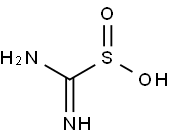
Preparative Methods of AMinoiMinoMethanesulfonic Acid: by the oxidation of thiourea or aminoiminomethanesulfinic acid (formamidinesulfinic acid) with Peracetic Acid. Many substituted aminoiminomethanesulfonic acids can be prepared in the same way. Others have utilized Hydrogen Peroxide with sodium molybdate as a catalyst to oxidize the corresponding thioureas to a variety of monosubstituted aminoiminomethanesulfonic acids; the substituents include phenyl, 2-methylphenyl, 4-fluorophenyl, n-propyl, cyclohexylmethyl, S-α- methylbenzyl, cyclooctyl, and benzhydryl.
Synthesis
General procedure for the synthesis of amino (imino) methanesulfonic acid from thiourea dioxide: [0246] amino imino methanesulfonic acid (3.7). The method developed by Mosher et al. was used. 1.56 mL of a 32% peracetic acid solution was added slowly and dropwise at 0 °C to 3.0 mL of glacial acetic acid solution containing 0.633 g (5.85 mmol) of thiourea dioxide (3.6). The reaction mixture was stirred at room temperature for 16 hours. Upon completion of the reaction, the precipitate was collected by filtration and washed with 5 parts of 5 mL of anhydrous ethanol and dried to give amino(imino)methanesulfonic acid (3.7) as a white crystalline solid: yield 596 mg (82%), melting point 125-126 °C.
Solubility in organics
Solubility of AMinoiMinoMethanesulfonic Acid: sol water; slightly sol methanol, ethanol; insol ether.
storage
AMinoiMinoMethanesulfonic Acid is stable for at least a few weeks at room temperature. After drying, it remains stable for at least 5 months if kept in a freezer. Thiourea and its metabolites (probably oxidized thiourea) are tumorigenic and cause lung edema. All direct contact with the compound should be avoided; for example, a dust mask should be worn. All residues should be destroyed with strong bleach solution. Many substituted thioureas and their metabolites are also biologically active. Use in a fume hood.
References
[1] Tetrahedron Letters, 1988, vol. 29, # 26, p. 3183 - 3186
[2] Synthetic Communications, 2001, vol. 31, # 19, p. 2891 - 2893
[3] Medicinal Chemistry, 2012, vol. 8, # 5, p. 928 - 933,6
[4] Patent: US2004/260073, 2004, A1. Location in patent: Page/Page column 15; 22
[5] Journal of the Chemical Society, Perkin Transactions 1: Organic and Bio-Organic Chemistry (1972-1999), 1992, # 23, p. 3179 - 3184