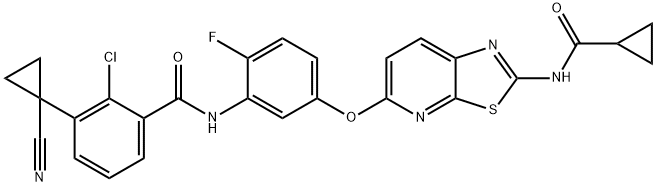
Uses
Takeda-6D (compound 6d) is an orally active and potent BRAF/VEGFR2 inhibitor, with IC50 values of 7.0 and 2.2 nM, respectively. Takeda-6D shows antiangiogenesis by suppressing the VEGFR2 pathway in 293/KDR and VEGF-stimulated HUVEC cells.Takeda-6D shows significant suppression of ERK1/2 phosphorylation. Takeda-6D shows antitumor activity[1].
Biological Activity
Takeda-6d is a dual inhibitor of RAF kinases and VEGFR2.1 It inhibits wild-type B-RAF, mutant B-RAFV600E, and C-RAF (IC50s = 12, 7, and 1.5 nM, respectively), as well as VEGFR2 (IC50 = 2.8 nM). Takeda-6d is selective for these kinases over a panel of 19 additional kinases (IC50s = >1,000 nM) but does inhibit FGFR3, PDGFRα, and PDGFRβ (IC50s = 22, 12, and 5.5 nM, respectively). It inhibits MEK and ERK1/2 phosphorylation in several colon cancer and melanoma cell lines expressing B-RAFV600E when used at concentrations ranging from 100 to 1,600 nM, as well as inhibits VEGF-A-induced phosphorylation of VEGFR2 in VEGFR2-overexpressing KDR cells (IC50 = 0.53 nM). Takeda-6d (10 mg/kg) reduces tumor volume in an A375 melanoma mouse xenograft model.
in vivo
Takeda-6D (compound 6d) (10 mg/kg, Orally, once) shows sufficient oral bioavailability (F = 70.5%) in rats[1].
Takeda-6D (0-10 mg/kg, Orally, once) significantly decreases phosphorylation levels of ERK1/24 h after oral administration in an A375 (BRAFV600E mutant) human melanoma xenograft model in rats[1].
Takeda-6D (10 mg/kg, Orally, twice daily for 2 weeks) shows tumor regression with T/Cof ?7.0% without severe toxicity, and this tumor regression should include the efficacy based on the antiangiogenesis potency and BRAF inhibitory activity[1].
IC 50
VEGFR2: 2.2 nM (IC50); Braf: 7.0 nM (IC50)
References
1.Okaniwa, M., Hirose, M., Imada, T., et al.Design and synthesis of novel DFG-out RAF/vascular endothelial growth factor receptor 2 (VEGFR2) inhibitors. 1. Exploration of [5,6]-fused bicyclic scaffoldsJ. Med. Chem.55(7)3452-3478(2012)