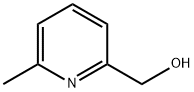
(a) glacial acetic acid was added to the reaction flask, followed by 2,6-dimethylpyridine, and heated until it was well mixed, and the mass ratio of glacial acetic acid to 2,6-dimethylpyridine was 2.5:1; (b) hydrogen peroxide and catalyst tungsten oxide were added sequentially to the reaction mixture of step (a), and the amount of tungsten oxide was added as 5% of the mass of 2,6-dimethylpyridine, and the amount of hydrogen peroxide was 2,6-dimethyl pyridine mass, and the reaction lasted for 3 hours; (c) an equal volume of 28% hydrogen peroxide was added to the reaction mixture of step (b) again, and the reaction was continued for 7 hours; (d) after the completion of the reaction, the reaction mixture was subjected to distillation under reduced pressure, and the fraction at 130-150 °C/12 mmHg was collected; (e) the fraction obtained in step (d) was refluxed with acetic anhydride at the ratio of 0.7:1 by volume, and at the end of the reaction, the reaction was allowed to proceed to the refluxing stage. Refluxing was carried out, and the glacial acetic acid was allowed to dry at the end of the reaction, after which the mother liquor was refluxed with 10% potassium hydroxide solution at the ratio of 1:3 by volume for 8 hours, and cooled to room temperature; (f) six countercurrent extractions were carried out on the reaction solution in step (e) with dichloromethane using two times the volume of dichloromethane each time, and the extracts were combined and distilled to recover the dichloromethane, to obtain 6-methyl-2-pyridine methanol. In this method, the yield of 6-methyl-2-pyridinemethanol was 94%, the reaction selectivity was 95.2%, and the purity of the final product was 99.1%, which met the requirements of the pharmaceutical industry.