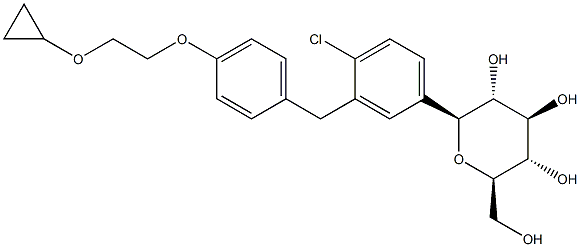
Example 5: Preparation of (2S,3R,4R,5S,6R)-2-(4-chloro-3-(4-(2-cyclopropoxyethoxy)benzyl)phenyl)-6-(hydroxymethyl)tetrahydro-2H-pyran-3,4,5-triol
[0236] This embodiment describes the preparation of (2S,3R,4R,5S,6R)-2-(4-chloro-3-(4-(2-cyclopropoxyethoxy)benzyl)phenyl)-6-(hydroxymethyl)tetrahydro-2H-pyran-3,4,5-triol by reduction of end-isomers OMe and/or OH.
Procedure.
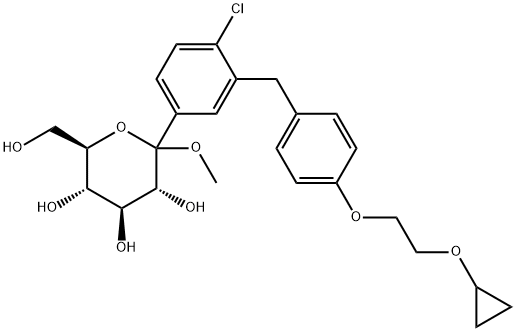
1. Add (3R,4S,5S,6R)-2-(4-chloro-3-(4-(2-cyclopropoxyethoxy)benzyl)phenyl)-6-(hydroxymethyl)-2-methoxytetrahydro-2H-pyran-3,4,5-triol crude (2.7 kg), dichloromethane (5.4 kg), and acetonitrile (3.2 kg) to a 30L glass reactor under nitrogen protection with magnetic stirred until complete dissolution.
2. In another vessel, boron trifluoride ethyl ether complex (2.34 kg) was added dropwise to a mixture of dichloromethane (5.4 kg) and acetonitrile (3.2 kg) of triethylsilane (2.55 kg) at -21 to -15 °C, maintaining a nitrogen atmosphere.
3. The feedstock solution prepared in step 1 was slowly added to the cold solution in step 2, and the addition rate was controlled to maintain the reaction temperature between -20 and -25°C (about 3 hours). After addition, the reaction continues to be stirred at -22 to -25°C for 4 hours.
4. Upon completion of the reaction, the reaction was quenched by the slow addition of 7.4% w/w aqueous sodium bicarbonate (18.3 kg), controlling the internal temperature to no more than -10°C. The reaction was then quenched by the addition of solid sodium bicarbonate (18.3 kg). Subsequently, solid sodium bicarbonate (1.35 kg) was added to adjust the pH to 7.5.
5. The solvent was removed by depressurized concentration (temperature < 40 °C) and the residue was partitioned with ethyl acetate (18 kg) and water (9.2 kg). The organic phase was separated and the aqueous phase was extracted with ethyl acetate (2 x 9 kg). The organic layers were combined and washed with saturated brine (2 x 9 kg).
6. The organic phase was concentrated to near dryness (temperature < 40 °C) under pressure, added anhydrous ethanol (9 kg) and concentrated again to give the crude product (2.5 kg, yield 90%, HPLC purity 90.8%, method HPLC-0001) as a foamy solid.