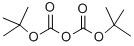
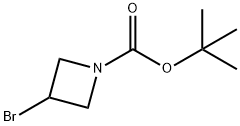
To a flame-dried 500 mL round-bottomed flask was added 1-amino-2,3-dibromopropane hydrobromide (17) (3.5 g, 11.8 mmol, 1 equiv.) and stirred solvent-free under argon protection to obtain a fine powder of 17 (or crystals of 17 were manually ground to a fine powder before use). Anhydrous THF (35 mL) was added to the flask and the mixture was cooled to -78°C. PhLi solution (1.8 M in dibutyl ether, 18.5 mL, 35.3 mmol, 3 eq.) was slowly added via syringe, and the reaction mixture was stirred for 2 hr at -78°C. Subsequently, MeCN (112 mL), LiBr (~42 g, 35.3 mmol, 3 eq.), and Boc2O (5.4 mL, 23.6 mmol, 2 eq.) were added to the reaction mixture, and the mixture was slowly warmed from -78°C to room temperature overnight. The reaction mixture was poured into water (200 mL) and washed sequentially with saturated aqueous NaHCO3, aqueous Na2S2O3 (50 mL), and then extracted with ether (3 x 150 mL). The organic layers were combined, washed with brine (50 mL), dried over Na2SO4 and concentrated. The crude product was purified by fast chromatography (silica gel, 5-20% EtOAc in hexane solution) to afford the target product tert-butyl 3-bromoazetidine-1-carboxylate (20) (2.21 g, 79%). Physical state: transparent liquid; Rf = 0.38 (1:9 EtOAc/hexane, KMnO4 color development); 1H NMR (500 MHz, CDCl3): δ 4.55-4.46 (m, 3H), 4.22-4.14 (m, 2H), 1.44 (s, 9H); 13C NMR (126 MHz, CDCl3): δ 155.8 , 80.2, 60.3 (br, 2C), 33.0, 28.4 (3C); all spectral data are in agreement with literature reports.


![1-Azabicyclo[1.1.0]butane](/CAS/GIF/19540-05-7.gif)