Chemical Properties, Toxicological Evidence, and Emerging Applications of Capstone 62-AL in Fluorinated Polyurethane Materials
Structural Characteristics and Functional Features of Capstone 62-AL
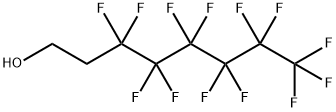
Capstone 62-AL has fluorotelomer functionality which is covalently bound as a side-chain to a polymer backbone, or to additional hydrocarbon groups to create fluorosurfactants. Polymeric products provide oil and water repellency and stain release protection that cannot be achieved with non-fluorinated alternatives. Fluorosurfactants provide unparalleled surface tension lowering, wetting and leveling properties. [1]

Systemic and Reproductive Toxicity Assessment of 6:2 Fluorotelomer Alcohol
Capstone 62-AL was evaluated for potential systemic repeated-dose and reproductive toxicity in mice. CD-1 mice were generally more sensitive than CD rats with respect to systemic toxicity from oral administration of Capstone 62-AL, and this was likely responsible for the more severe effects observed in the offspring (i.e., pup growth and viability) at doses where systemic effects were observed. The liver was the primary target organ in both species, evidenced by increased liver size, trophic and toxic histopathologic effects, and elevations in clinical chemistry parameters that were consistent with hepatotoxicity. Mortality, clinical abnormalities, red blood cell changes, and reductions in male body weights were consistent across species, but the reduction in P1 female body weight during lactation was markedly greater in mice than in rats. Correspondingly, changes in the female reproductive tract and mammary gland secondary to body weight decrements were observed only in mice, and the magnitude of the reductions in lactation index and pup body weight were greater in mice than in rats. While the severity of the effects was generally greater in mice than rats, the overall NOAELs were identical in both species, 5 mg/kg/day for systemic toxicity and 25 mg/kg/day for offspring viability/growth. Capstone 62-AL was not a selective reproductive toxicant in either species; no effects on reproductive outcome occurred at any dose level, and any effects observed in offspring occurred at dose levels that induced mortality and severe toxicity in maternal animals. [1]
Synthesis of Fluorinated Castor-Oil-Based Polyols Using Capstone 62-AL and Their Property Enhancements
Polyurethanes (PUs), containing a repeating urethane linkage and having alternating hard and soft segments, exhibit a typical two-phase microstructure and have found wide applications in coating, elastomers, adhesives and medical devices due to their good mechanical properties and biocompatibility. However, polyether polyols, as a key raw material for the preparation of PUs, are mostly produced from a limited petroleum resource, which limits the development of the PU industry A novel castor oil-based polyols with fluorine-containing pendant groups (CO-FPOL) has been synthesized through ring-opening polymerization from castor oil (CO), propylene oxide (PO) and self-made 3-(3,3,4,4,5,5,6,6,7,7,8,8,8-tridecafluoro-octyloxymethyl)-Oxirane (TDFOMO). The TDFOMO was synthesized from Capstone 62-AL and Epichlorohydrin (ECH). Then, the CO-FPOLs further reacted with a 4,4′-diphenylmethane diisocyanate (MDI) to prepare a one-component fluorinated polyurethane coating (CO-FPUP). Strikingly, the fluorine content of CO-FPOL can be easily controlled, the thermal stability of CO-FPOL and CO-FPUP increased with the increasing of fluorine content. It was all found that with the fluorine content of CO-FPOL increasing from 0% to 17.72%, the static water contact angle of CO-FPUPs increased from 90° to 106°, and the static oil contact angle of CO-FPUPs increased from 20° to 54°. The XPS survey spectra revealed that the fluorine in the cured polyurethane would migrate to the surface easier due to the fluorinated pendant groups which moving easier between molecular chains. All the above results suggest that the introduction of fluorinated pendant groups in polyether polyol has great improvements in the thermal stability and the hydrophobic and oleophobic properties of polymer materials. [2]
Capstone 62-AL–Derived Fluoroalcohol Trimer in Waterborne Polyurethanes and Its Impact on Wettability
Waterborne polyurethane (WPU) is an nontoxic and environment friendly material, which has been used in various fields, such as adhesive, leather/synthetic finishing, textile laminating, plastic printing and wood coating, etc. Water used as a solvent often results in some defects such as high surface tension, poor wetting and spreading ability together with water/solvent resistance of WPU on low surface free energy substrates, which limits it application. A series of fluorine-containing water-based polyurethane (FWPU) were synthesized by using fluoro alcohol-terminated isocyanate trimer (F-HDIT) prepared from Capstone 62-AL and hexamethylene diisocyanate trimer (HDIT). The surface tension of FWPU emulsions was decreased and the wetting ability of FWPU films was improved. [3]
References:
[1] Stakhanov, A. I., Elmanovich, I. V., Kravchenko, E. I., Khakina, E. A., Pavlov, A. A., Kharitonova, E. P., ... & Gallyamov, M. O. (2023). New fluorinated cyclophosphazenes: Synthesis, properties, applications. Phosphorus, Sulfur, and Silicon and the Related Elements, 198(4), 321-329.
[2] Zong, H., Zhao, X., Wu, C., & Fang, C. (2024). Synthesis and characterization of castor oil-based polyols with fluorine-containing pendant groups. Journal of Adhesion Science and Technology, 38(5), 795-814.
[3] Wen, J., Sun, Z., Fan, H., Chen, Y., & Yan, J. (2019). Synthesis and characterization of a novel fluorinated waterborne polyurethane. Progress in Organic Coatings, 131, 291-300.
You may like


Lastest Price from 1H,1H,2H,2H-PERFLUORO-1-OCTANOL manufacturers
US $0.00/KG2025-04-21
- CAS:
- 647-42-7
- Min. Order:
- 1KG
- Purity:
- 98%min
- Supply Ability:
- 30tons/month
US $0.00-0.00/KG2025-04-15
- CAS:
- 647-42-7
- Min. Order:
- 1KG
- Purity:
- 99%
- Supply Ability:
- 500000kg