Benzyl Mercaptan: Reactive Thiol Intermediate
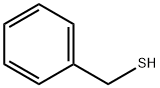
Benzyl mercaptan, also known as benzyl thiol, has a strong, pungent, mercaptan-like odor. It is insoluble in water but readily soluble in organic solvents such as ethanol, diethyl ether, and benzene. When exposed to air, it readily oxidizes to form dibenzyl disulfide. The molecule contains a reactive thiol group, enabling it to undergo addition, salt formation, and coordination reactions. It serves as a key thiol intermediate in the synthesis of pharmaceuticals, pesticides, and fragrances, and is also used as a metal surface complexing corrosion inhibitor and a reagent for the extraction of precious metals.

Molecular Recognition in the Benzyl Mercaptan Dimer
Molecular recognition is especially interesting between chiral species, as it may provide insight into biochemical docking, asymmetric synthesis, and chiral analysis. Among chiral molecules, those with very low (5–10 kJ mol−1) torsional stereomutation barriers display transient chirality. Transient enantiomers interconvert in nanosecond time scales that would be undetectable with conventional techniques. However, transient chirality can be revealed by the formation of diastereomeric dimers in the gas phase, simultaneously freezing stereomutation and providing information on the structural and energetic factors controlling homo- or heterochiral aggregation. Scientists selected benzyl mercaptan as a dimerization target. Benzyl mercaptan represents an extension of our previous investigation on thiophenol dimerization and will establish if the two rings maintain the π-stacking thiophenol arrangement or tilted geometries similar to the benzyl alcohol dimer, recently revisited. Additionally, it will discern whether the homochiral aggregation of benzyl alcohol is respected in the mercaptan and the structural and physical differences in the S-H···S hydrogen bond compared to the canonical O-H···O hydrogen bond. Benzyl mercaptan displays a bidimensional potential energy surface, qualitatively similar to benzyl alcohol. The two torsional degrees of freedom are associated with the elevation and orientation of the terminal thiol group, given by dihedrals τ1(SCα-CipsoCortho) and τ2(HS-CαCipso). Our previous rotational investigation of benzyl mercaptan confirmed that the monomer presents a single isomer in the gas phase, as in the alcohol. In this conformation the sulfur atom is synclinal to the ring plane (τ1~ ±74° vs. ±55° in benzyl alcohol) and the thiol hydrogen is synchronously oriented towards the π ring (τ2~ ±74° vs. ±53° in benzyl alcohol), denoted gauche-gauche or GG.[1]
The benzyl mercaptan dimer is a model cluster with a primary amphoteric thiol group and a combination of aliphatic proton donors and a π ring acceptor. The methylene pivot between the thiol and the aromatic ring permits some conformational flexibility and a variety of intermolecular forces, generally balancing two cooperative interactions. The rotational spectrum confirmed a single isomer in the gas phase, providing data for comparison between experiment and theory. The observed global minimum (GG-GG-Lp−) is homochiral and characterized by a leading thiol-thiol (S-H···S) hydrogen bond, in cooperation with a secondary thiol-aromatic (S-H···π) hydrogen bond. Characteristically, this interaction pattern and stereochemistry is coincident with the most stable (hom-Ogπ-I) benzyl alcohol dimer, stabilized by stronger O-H···O and O-H···π alcohol hydrogen bonds. The second isomer of the mercaptan dimer (GG-GG-Lp+), separated 1.7 kJ mol−1 (B2PLYP)–1.8 kJ mol−1 (B3LYP), differs in the use of a different sulfur lone-pair in the acceptor molecule but maintains its homochiral character. The equivalent isomer in the alcohol (hom-Otπ-V: 3.2 kJ mol−1) is much higher in energy. Consequently, the benzyl mercaptan dimer shows a reinforced preference for homochirality compared to the alcohol, where the heterochiral isomer (het-Ogπ-II) is nearly isoenergetic (0.2 kJ mol−1) with the (hom-Ogπ-I) global minimum. Differences in the physical forces operating in the benzyl mercaptan and alcohol dimers are notorious in the topological analysis of the electronic density and the SAPT energy decomposition. The weaker, dispersive character of the thiol dimer, thus, contributes to a better description of non-covalent forces involving low-electronegativity atoms.
Covalent Imprinting and Covalent Rebinding of Benzyl Mercaptan
A novel synthetic benzyl mercaptan receptor with tunable binding sites was prepared by covalent imprinting using a disulfide linkage which was cleaved and able to recognize the benzyl mercaptan templates by reforming disulfide bonds through thiol–disulfide exchange. These covalently molecularly imprinted polymers were prepared using ambient ultraviolet radiation in comparison with thermal cross-linking at 80°C. Subsequent reduction of disulfide bonds resulted in the formation of surface thiol groups, followed by modification forming sodium thiolate as covalent binding sites. Covalent imprinting was found to be complementary in size, spatial effects, and chemical reactivity to benzyl mercaptan. This covalent rebinding and other various guest molecules were prepared by reforming disulfide bonds at room temperature in protic solvents. The results showed that rapid covalent rebinding is more efficient than other noncovalent interactions.[2]
Dissociation Reaction of Benzyl Alcohol and Benzyl Mercaptan on Ge(100) Surface
Group 14 (100) semiconductor surfaces have a limitless potential to manifest into complex materials with desired characteristics when combined with the specific functional groups of organic compounds and biomolecules. For instance, functionalization through reaction with biomolecules, such as amino acids and DNA nucleobases, allows (100) semiconductor surfaces to serve as sensors for detecting biological signals. Benzyl alcohol and benzyl mercaptan consist of a phenyl ring bearing hydroxymethyl and mercaptomethyl group, respectively. Benzyl alcohol can act an indicator of photocatalytic performance in the selective oxidation of an alcohol to an aldehyde on a TiO2 semiconductor photocatalyst. Benzyl mercaptan plays a role in improving the stability of CdS semiconductor nanocrystals by acting as a capping agent for the protection of the nanoparticle surface during synthesis. On the Ge(100) surface, the lone-pair electrons of the oxygen or sulfur atom of the molecule react with the electrophilic “down” atom of the surface dimer of Ge(100) via a Lewis acid–base reaction. This leads to the formation of a dative bonded product, which exists as either a stable adsorbate itself or a precursor to a subsequent dissociation product. Accordingly, benzyl alcohol and benzyl mercaptan are expected to be adsorbed on the Ge(100) surface without the surface reaction of their aromatic rings, which is capable of a carrier channel. Nevertheless, because the reaction behavior of a molecule can vary depending on its molecular structure, it should be confirmed whether the phenyl rings of benzyl alcohol and benzyl mercaptan do not react when the molecules are adsorbed on the Ge(100) surface. The adsorption structures of benzyl alcohol and benzyl mercaptan on the Ge(100) surface were examined by using high-resolution photoemission spectroscopy (HRPES) and density functional theory (DFT) calculations. The HRPES and DFT results clearly verified that the adsorption of these molecules occurs through an on-top dissociative pathway to form the corresponding on-top dissociated structure.[3]
References
[1]Saragi, R. T., Juanes, M., Pinacho, R., Rubio, J. E., Fernández, J. A., & Lesarri, A. (2021). Molecular Recognition, Transient Chirality and Sulfur Hydrogen Bonding in the Benzyl Mercaptan Dimer. Symmetry, 13(11), 2022. https://doi.org/10.3390/sym13112022
[2]Burri, H. R., & Yu, D. (2017). Covalent Imprinting and Covalent Rebinding of Benzyl Mercaptan: Towards a Facile Detection of Proteins. Analytical Letters, 50 1, 866–876. https://doi.org/10.1080/00032719.2016.1196694
[3]Lee, Y. J., Ryu, S., & Youn, Y.-S. (2024). Dissociation Reaction of Benzyl Alcohol and Benzyl Mercaptan on Ge(100) Surface. The Journal of Physical Chemistry C, 1 1. https://doi.org/10.1021/acs.jpcc.4c03916
You may like
See also

Lastest Price from Benzyl mercaptan manufacturers

$1.002025-04-21
- CAS:
- 100-53-8
- Min. Order:
- 1kg
- Purity:
- 99%
- Supply Ability:
- 10 mt
$990.002024-07-25
- CAS:
- 100-53-8
- Min. Order:
- 1Kg
- Purity:
- 98
- Supply Ability:
- 500 Kg