Application research of Methyl 2-benzoylbenzoate
Introduction
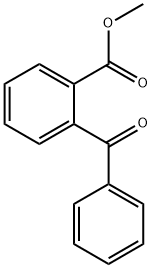
Photoinitiators are used in a broad range of commercial and biological applications, such as printing,dentistry, encapsulation of pancreatic islet cells,and blood vessel adhesives. In previous studies, free-radical photoinitiators, i.e.,1-hydroxycyclohexyl phenyl ketone (1-HCHPK), methyl 2-benzoylbenzoate (MBB), and 2-methyl-4′-(methylthio)-2-morpholinopropiophenone (MTMP), were detected in intravenous injection solutions. These photoinitiators are found in the ink used to print the outer surfaces of plastic containers. Shen et al. have shown that photoinitiators can easily migrate from plastic packaging to foods with high fat contents. These results indicate that photoinitiators can pass through plastic containers.[1-2]The basic structures of photoinitiators, especially methyl 2-benzoylbenzoate (Figure 1), are similar to di(2-ethylhexyl) phthalate. Thus, it was of interest to examine the effects of photoinitiators, which are used frequently, on endocrine tissue disruption.
In vitro quantitative determination of the concentration of the polymerization agent methyl 2-benzoylbenzoate
In previous studies, we detected the photoinitiators 1-hydroxycyclohexyl phenyl ketone (1-HCHPK) and 2-methyl-4'-(methylthio)-2-morpholinopropiophenone (MTMP) in an intravenous injection solution. Importantly, 1-HCHPK and MTMP have been demonstrated to be cytotoxic to normal human peripheral blood (PB) mononuclear cells (MNC). Cell death (apoptosis) pathways can be classified into two modes, caspase-dependent and -independent pathways. However, it is unclear whether methyl 2-benzoylbenzoate (MBB) induces the caspase-dependent and/or -independent pathway in normal human PBMNC. In the present in vitro study, we examined the levels of MBB in a solution from an intravenous fluid bag and the cytotoxicity of MBB towards normal human PBMNC via the caspase-8-, caspase-9-, or apoptosis-inducing factor (AIF)-mediated apoptosis pathways. We found that extracts from the injection solution had been contaminated with approximately 80 μM of the photoinitiator MBB. In addition, MBB induced apoptosis in the high concentration range in normal human PBMNC in vitro. Moreover, we found that MBB-induced apoptosis occurs via the caspase-9 pathway, but not the AIF pathway. In conclusion, we suggest that MBB has cytotoxic effects on normal human PBMNC in vitro, which are mediated via the caspase-dependent pathway.[3]
Photoinitiator-initiated estrogenic activity in human breast cancercell line MCF-7
This study was to assess the association between estrogenic activity and exposure to photoinitiators. For estimation of the proliferative effect of the photoinitiators, the E-screen assay was used. Six photoinitiators, 2,2-dimethoxy-2-phenylacetophenone (2,2-DMPAP), 2-ethylhexyl 4-(dimethylamino)benzoate (2-EHDAB), 1-HCHPK, 2-ITX, methyl 2-benzoylbenzoate(MBB), and MTMP, significantly increased number of MCF-7 cells, an estrogen-sensitive human breast cancer cell line. In addition, pretreatment with estrogen receptor (ER) antagonists such as clomiphene, tamoxifen, or fulvestrant, significantly reversed the proliferative effect of each photoinitiator. Data demonstrated that the six photoinitiators produced endocrine-disrupting effects and that these photoinitiators interacted with ER as agonists.Evidence indicates that the six photoinitiators demonstrated estrogenic activity via ER as agonists.[1]
In vitro mutagenicity of the photoinitiators
In previous studies, Takai et al. detected the photoinitiators 1-hydroxycyclohexyl phenyl ketone (1-HCHPK), methyl 2-benzoylbenzoate (MBB), and 2-methyl-4'-(methylthio)-2-morpholinopropiophenone (MTMP) in intravenous injection solutions. In addition,Takai et al. reported that 1-HCHPK, methyl 2-benzoylbenzoate, and MTMP exhibited cytotoxicity towards normal human peripheral blood mononuclear cells. A previous in vitro study reported that a free-radical photoinitiator introduced covalently bound purine residues into DNA. However, little is known about the in vitro mutagenicity of 1-HCHPK, methyl 2-benzoylbenzoate, and MTMP. In the present in vitro study, researchers evaluated the mutagenicity of 1-HCHPK, MBB, and MTMP using the Ames test. They found that untreated 1-HCHPK, methyl 2-benzoylbenzoate, and MTMP were not mutagenic in S. typhimurium strain TA97, TA98, TA100, TA102, or TA1535, regardless of the presence/absence of S9 activation. However, ultraviolet (UV) light-irradiated MTMP exhibited mutagenicity in S. typhimurium strain TA97 in the absence of S9 activation. In conclusion, Takai et al. suggest that exposure to UV-irradiated MTMP, including in intravenous injection solutions, can result in frameshift mutations.[2]
Photoinitiators enhanced 1,2-dichloropropane-induced cytotoxicity
Dichloromethane (DCM) and 1,2-dichloropsropane (DCP) have various uses, including being solvents for paint removers. Photoinitiators are also used in a wide range of commercial applications such as printing. These chemicals have been shown to induce cytotoxic effects. In the present study, Kawasaki et al. evaluated the combined effects of DCM or DCP from paint removers and photoinitiators used in printing on normal human embryonic lung fibroblasts with the aim of preventing occupational injuries. Kawasaki et al. showed that DCP, 2,2-dimethoxy-2-phenylacetophenone (2,2-DMPAP), 2-ethylhexyl-4-(dimethylamino) benzoate (2-EHDAB), 1-hydroxycyclohexyl phenyl ketone (1-HCHPK), and methyl 2-benzoylbenzoate (MBB) induced cytotoxicity, whereas DCM and 2-isopropylthioxanthone (2-ITX) did not. In addition, 2-methyl-4'-(methylthio)-2-morpholinopropiophenone (MTMP) caused a slight increase in cytotoxicity. The combination of DCP and the four photoinitiators (2,2-DMPAP, 2-EHDAB, MBB, and MTMP) significantly induced cytotoxicity and also led to apoptosis. In conclusion, the combination of DCP and photoinitiators may increase the risk of respiratory diseases.[4]
References
[1]. Morizane M, Kawasaki Y, Miura T, et al. Photoinitiator-Initiated Estrogenic Activity in Human Breast Cancer Cell Line MCF-7. J Toxicol Environ Health A. 2015;78(23-24):1450-1460. doi:10.1080/15287394.2015.1094431
[2]. Takai M, Kawasaki Y, Arimoto S, Tanimoto Y, Kitamura Y, Sendo T. UV-irradiated 2-methyl-4'-(methylthio)-2-morpholinopropiophenone-containing injection solution produced frameshift mutations in the Ames mutagenicity assay. Environ Sci Pollut Res Int. 2018;25(10):10135-10140. doi:10.1007/s11356-018-1539-8
[3]. Tsuboi C, Kawasaki Y, Yoshitome K, et al. In vitro quantitative determination of the concentration of the polymerization agent methyl 2-benzoylbenzoate in intravenous injection solution and the cytotoxic effects of the chemical on normal human peripheral blood mononuclear cells. Environ Sci Pollut Res Int. 2016;23(10):10262-10269. doi:10.1007/s11356-016-6332-y
[4]. Kawasaki Y, Tsuboi C, Yagi K, et al. Photoinitiators enhanced 1,2-dichloropropane-induced cytotoxicity in human normal embryonic lung fibroblasts cells in vitro. Environ Sci Pollut Res Int. 2015;22(6):4763-4770. doi:10.1007/s11356-014-3939-8

Lastest Price from Methyl 2-benzoylbenzoate manufacturers
US $0.00/kg2025-09-04
- CAS:
- 606-28-0
- Min. Order:
- 1kg
- Purity:
- 99%min
- Supply Ability:
- 20tons
US $0.00/KG2025-04-21
- CAS:
- 606-28-0
- Min. Order:
- 1KG
- Purity:
- 98%min
- Supply Ability:
- 30tons/month