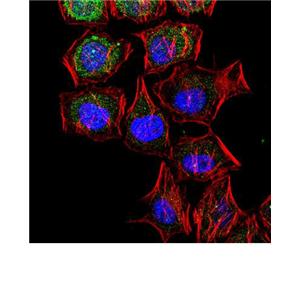
产品概述
| 产品名称(Product Name) | RSAD2 Rabbit Polyclonal Antibody |
| 描述(Description) | Rabbit Polyclonal Antibody |
| 宿主(Host) | Rabbit |
| 应用(Application) | WB,IHC-P,IF-P,IF-F,ICC/IF,ELISA |
| 种属反应性(Reactivity) | Human,Rat,Mouse |
产品性能
| 偶联物(Conjugation) | Unconjugated |
| 修饰(Modification) | Unmodified |
| 同种型(Isotype) | IgG |
| 克隆(Clonality) | Polyclonal |
| 形式(Form) | Liquid |
| 存放说明(Storage) | Store at 4°C short term. Aliquot and store at -20°C long term. Avoid freeze/thaw cycles. |
| 储存溶液(Buffer) | Liquid in PBS containing 50% glycerol, 0.5% BSA and 0.02% New type preservative N. |
| 纯化方式(Purification) | Affinity purification |
免疫原
| 基因名(Gene Name) | RSAD2 |
| 别名(Alternative Names) | RSAD2; CIG5; Radical S-adenosyl methionine domain-containing protein 2; Cytomegalovirus-induced gene 5 protein; Viperin; Virus inhibitory protein, endoplasmic reticulum-associated, interferon-inducible |
| 基因ID(Gene ID) | 91543 |
| 蛋白ID(SwissProt ID) | Q8WXG1 |
产品应用
| 稀释比(Dilution Ratio) | WB 1:500-1:2000, IHC-P 1:100-1:300, ELISA 1:20000, IF-P/IF-F/ICC/IF 1:50-200 |
| 蛋白分子量(Molecular Weight) | 42kDa |
研究背景
cofactor:Binds 1 4Fe-4S cluster. The cluster is coordinated with 3 cysteines and an exchangeable S-adenosyl-L-methionine.,function:Involved in antiviral defense. May impair virus budding by disrupting lipid rafts at the plasma membrane, a feature which is essential for the budding process of many viruses. Acts through binding with and inactivating FPPS, an enzyme involved in synthesis of cholesterol, farnesylated and geranylated proteins, ubiquinones dolichol and heme. Plays a major role in the cell antiviral state induced by type I and type II interferon. Displays antiviral effect against HIV-1 virus, hepatitis C virus, human cytomegalovirus, and aphaviruses, but not vesiculovirus.,induction:By interferon type I, type II and LPS. Little or no induction by interferon gamma is observed in monocytic cell lines. Induced by infection with human cytomegalovirus (HMCV), hepatitis C virus, yellow fever virus and Sendai virus, presumably through type I interferon pathway.,miscellaneous:Up-regulated in atherosclerosis. Latent viruses like HCMV may be involved in atherogenesis by initiating local inflammation. This may induce up-regulation of antiviral gene RSAD2, which modulates lipids synthesis, and thus could play a role in abnormal lipid accumulation leading to atherosclerosis.,similarity:Belongs to the RSAD2 family.,subcellular location:Probably associates with the cytosolic side of the endoplasmic reticulum. Infection with human cytomegalovirus (HCMV) causes relocation to the Golgi apparatus and to cytoplasmic vacuoles which also contain HCMV proteins glycoprotein B and pp28.,subunit:Interacts with FPPS.,cofactor:Binds 1 4Fe-4S cluster. The cluster is coordinated with 3 cysteines and an exchangeable S-adenosyl-L-methionine.,function:Involved in antiviral defense. May impair virus budding by disrupting lipid rafts at the plasma membrane, a feature which is essential for the budding process of many viruses. Acts through binding with and inactivating FPPS, an enzyme involved in synthesis of cholesterol, farnesylated and geranylated proteins, ubiquinones dolichol and heme. Plays a major role in the cell antiviral state induced by type I and type II interferon. Displays antiviral effect against HIV-1 virus, hepatitis C virus, human cytomegalovirus, and aphaviruses, but not vesiculovirus.,induction:By interferon type I, type II and LPS. Little or no induction by interferon gamma is observed in monocytic cell lines. Induced by infection with human cytomegalovirus (HMCV), hepatitis C virus, yellow fever virus and Sendai virus, presumably through type I interferon pathway.,miscellaneous:Up-regulated in atherosclerosis. Latent viruses like HCMV may be involved in atherogenesis by initiating local inflammation. This may induce up-regulation of antiviral gene RSAD2, which modulates lipids synthesis, and thus could play a role in abnormal lipid accumulation leading to atherosclerosis.,similarity:Belongs to the RSAD2 family.,subcellular location:Probably associates with the cytosolic side of the endoplasmic reticulum. Infection with human cytomegalovirus (HCMV) causes relocation to the Golgi apparatus and to cytoplasmic vacuoles which also contain HCMV proteins glycoprotein B and pp28.,subunit:Interacts with FPPS.,
研究领域