产品概述
| 产品名称(Product Name) | NFATc4 Rabbit Polyclonal Antibody |
| 描述(Description) | Rabbit Polyclonal Antibody |
| 宿主(Host) | Rabbit |
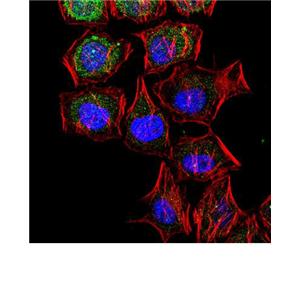
| 应用(Application) | WB,IHC-P,IF-P,IF-F,ICC/IF,ELISA |
| 种属反应性(Reactivity) | Human,Mouse |
产品性能
| 偶联物(Conjugation) | Unconjugated |
| 修饰(Modification) | Unmodified |
| 同种型(Isotype) | IgG |
| 克隆(Clonality) | Polyclonal |
| 形式(Form) | Liquid |
| 存放说明(Storage) | Store at 4°C short term. Aliquot and store at -20°C long term. Avoid freeze/thaw cycles. |
| 储存溶液(Buffer) | Liquid in PBS containing 50% glycerol, 0.5% BSA and 0.02% New type preservative N. |
| 纯化方式(Purification) | Affinity purification |
免疫原
| 基因名(Gene Name) | NFATC4 |
| 别名(Alternative Names) | NFATC4; NFAT3; Nuclear factor of activated T-cells; cytoplasmic 4; NF-ATc4; NFATc4; T-cell transcription factor NFAT3; NF-AT3 |
| 基因ID(Gene ID) | 4776 |
| 蛋白ID(SwissProt ID) | Q14934 |
产品应用
| 稀释比(Dilution Ratio) | WB 1:500-1:2000, IHC-P 1:100-1:300, IF-P/IF-F/ICC/IF 1:200-1:1000, ELISA 1:10000.Not yet tested in other applications. |
| 蛋白分子量(Molecular Weight) | 135kDa |
研究背景
This gene encodes a member of the nuclear factor of activated T cells (NFAT) protein family. The encoded protein is part of a DNA-binding transcription complex. This complex consists of at least two components: a preexisting cytosolic component that translocates to the nucleus upon T cell receptor stimulation and an inducible nuclear component. NFAT proteins are activated by the calmodulin-dependent phosphatase, calcineurin. The encoded protein plays a role in the inducible expression of cytokine genes in T cells, especially in the induction of interleukin-2 and interleukin-4. Alternative splicing results in multiple transcript variants. [provided by RefSeq, Jan 2014],domain:Rel Similarity Domain (RSD) allows DNA-binding and cooperative interactions with AP1 factors.,function:Plays a role in the inducible expression of cytokine genes in T-cells, especially in the induction of the IL-2 and IL-4. Transcriptionally repressed by estrogen receptors; this inhibition is further enhanced by estrogen. Increases the transcriptional activity of PPARG and has a direct role in adipocyte differentiation. May play an important role in myotube differentiation. May play a critical role in cardiac development and hypertrophy. May play a role in deafferentation-induced apoptosis of sensory neurons.,PTM:Phosphorylated by NFATC-kinases; dephosphorylated by calcineurin. Phosphorylated on Ser-168 and Ser-170 by FRAP1, IRAK1, MAPK7 and MAPK14, on Ser-213 and Ser-217 by MAPK8 and MAPK9, and on Ser-289 and Ser-344 by RPS6KA3. Phosphorylated by GSK3B.,PTM:Ubiquitinated, leading to its degradation by the proteasome and reduced transcriptional activity. Ubiquitination and reduction in transcriptional activity can be further facilitated through GSK3B-dependent phosphorylation. Polyubiquitin linkage is mainly through 'Lys-48'.,similarity:Contains 1 IPT/TIG domain.,similarity:Contains 1 RHD (Rel-like) domain.,subcellular location:Cytoplasmic for the phosphorylated form and nuclear after activation that is controlled by calcineurin-mediated dephosphorylation. Rapid nuclear exit of NFATC is thought to be one mechanism by which cells distinguish between sustained and transient calcium signals. The subcellular localization of NFATC plays a key role in the regulation of gene transcription.,subunit:Member of the multicomponent NFATC transcription complex that consists of at least two components, a pre-existing cytoplasmic component NFATC2 and an inducible nuclear component NFATC1. Other members such as NFATC4, NFATC3 or members of the activating protein-1 family, MAF, GATA4 and Cbp/p300 can also bind the complex. NFATC proteins bind to DNA as monomers. Interacts with CREBBP, GATA4, IRAK1, MAPK8, MAPK9 and RPS6KA3.,tissue specificity:Highly expressed in placenta, lung, kidney, testis and ovary. Weakly expressed in spleen and thymus. Not expressed in peripheral blood lymphocytes. Detected in hippocampus.,
研究领域
MAPK_ERK_Growth;MAPK_G_Protein;WNT;WNT-T CELLAxon guidance;VEGF;Natural killer cell mediated cytotoxicity;T_Cell_Receptor;B_Cell_Antigen;